


Page 279 - Gear Technology Solutions
P. 279
19.4  Starting at Full Output Load

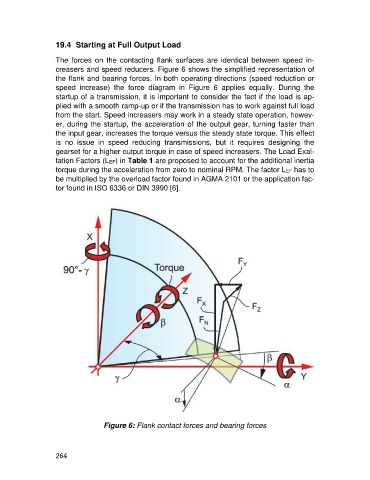
                   The  forces  on  the  contacting  flank  surfaces  are  identical  between  speed  in-
                   creasers and speed reducers. Figure 6 shows the simplified representation of
                   the flank and bearing forces. In both operating directions (speed reduction or
                   speed  increase)  the  force  diagram  in  Figure  6  applies  equally.  During  the
                   startup of a transmission, it is important to consider the fact if the load is ap-
                   plied with a smooth ramp-up or if the transmission has to work against full load
                   from the start. Speed increasers may work in a steady state operation, howev-
                   er, during the startup, the acceleration of the output gear, turning faster than
                   the input gear, increases the torque versus the steady state torque. This effect
                   is  no  issue  in  speed  reducing  transmissions,  but  it  requires  designing  the
                   gearset for a higher output torque in case of speed increasers. The Load Exal-
                   tation Factors (LEF) in Table 1 are proposed to account for the additional inertia
                   torque during the acceleration from zero to nominal RPM. The factor LEF has to
                   be multiplied by the overload factor found in AGMA 2101 or the application fac-
                   tor found in ISO 6336 or DIN 3990 [6].


                                   Figure 6: Flank contact forces and bearing forces


                   264

