


Page 277 - Gear Technology Solutions
P. 277
Profile shift might be necessary for the ratio shown in Figure 3 in order to avoid
                   undercut and achieve a large active working profile. For speed increasers with
                   a ratio greater than 3, the root transition of both the driving gear and the driven
                   pinion are prone to scuffing. In order to keep the sliding velocities low, close to
                   the transition to the root area, the profile shift of pinion and gear should be ze-
                   ro or very low. This translates to an addendum modification  factor which re-
                   sults in a pinion and gear dedendum (listed in the dimension sheet) which is
                   about 50% of the working depth.


                   19.3  Specific Sliding and Lubrication

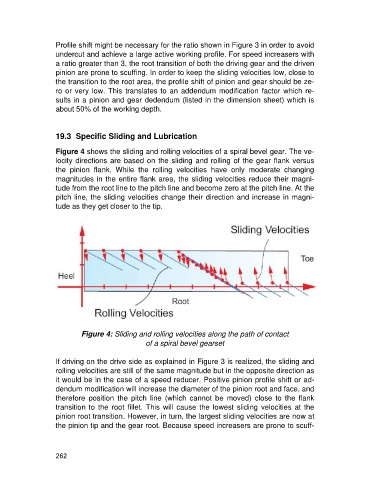
                   Figure 4 shows the sliding and rolling velocities of a spiral bevel gear. The ve-
                   locity directions are based on the sliding and rolling of the gear flank versus
                   the  pinion  flank.  While  the  rolling  velocities  have  only  moderate  changing
                   magnitudes in the entire flank area, the sliding velocities reduce their magni-
                   tude from the root line to the pitch line and become zero at the pitch line. At the
                   pitch line, the sliding velocities change their direction and increase in magni-
                   tude as they get closer to the tip.


                            Figure 4: Sliding and rolling velocities along the path of contact
                                                 of a spiral bevel gearset

                   If driving on the drive side as explained in Figure 3 is realized, the sliding and
                   rolling velocities are still of the same magnitude but in the opposite direction as
                   it would be in the case of a speed reducer. Positive pinion profile shift or ad-
                   dendum modification will increase the diameter of the pinion root and face, and
                   therefore  position  the  pitch  line  (which  cannot  be  moved)  close  to  the  flank
                   transition to  the root fillet.  This will  cause the  lowest sliding  velocities  at  the
                   pinion root transition. However, in turn, the largest sliding velocities are now at
                   the pinion tip and the gear root. Because speed increasers are prone to scuff-


                   262

