


Page 274 - Gear Technology Solutions
P. 274
19       Bevel Gear Speed Increasers


                   19.1  What is Different in Speed Increasers versus Speed Reducers?

                   For  cylindrical  gears,  speed  increasing  transmission  stages  are  well  known
                   and regarding profile shift, preferred pressure angles and helix angles a set of
                   rules applies, which is not much different from the rules for speed reducers [1].
                   It is important to acknowledge that basically a speed increaser has to be de-
                   signed just like a speed reducer, but then the gear with the lower number of
                   teeth is the output. Of course, the torque and the speed of the gear with the
                   lower number of teeth (output) and the gear with the higher number of teeth
                   (input) must be the same as if this transmission was used as a speed reducer.


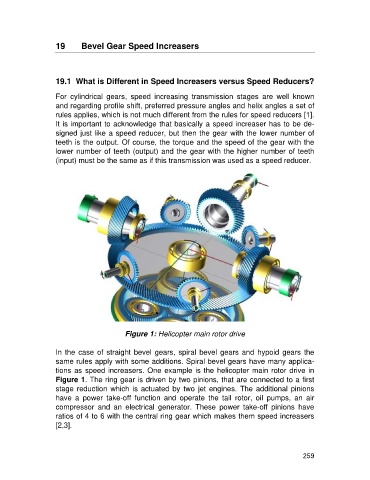
                                          Figure 1: Helicopter main rotor drive

                   In  the  case  of straight bevel gears, spiral bevel gears  and  hypoid  gears  the
                   same rules apply with some additions. Spiral bevel gears have many applica-
                   tions as speed increasers. One example is the helicopter main rotor drive in
                   Figure 1. The ring gear is driven by two pinions, that are connected to a first
                   stage  reduction which is actuated by  two jet  engines. The  additional pinions
                   have  a  power  take-off  function  and  operate  the  tail  rotor,  oil  pumps,  an  air
                   compressor  and  an  electrical  generator.  These  power  take-off  pinions  have
                   ratios of 4 to 6 with the central ring gear which makes them speed increasers
                   [2,3].


                                                                                                     259

