


Page 278 - Gear Technology Solutions
P. 278
ing  at  the  pinion  and  gear  root,  it  is  recommended  to  avoid  profile  shift  to
                   achieve balanced conditions between both meshing members.

                   In order to further reduce the risk of scuffing and the risk of lubrication defi-
                   ciencies, the applied lubrication concept is most important. The optimal orien-
                   tation of a speed increasing gearbox is such that the gear has a horizontal axis
                   and is about 50% below the oil level, while the pinion just dips below the oil
                   level.  This  orientation  will  keep  oil  churning  at  the  lowest  possible  level  and
                   forced  lubrication  is  not  required.  The  basic  rule  is  to  keep  the  low-speed
                   member about 50% below the oil and ensure that the high-speed member just
                   contacts the oil, such that after long periods of not operating the gearbox, the
                   pinion is not dried off on all of its teeth.

                   Recommended oil types are high pressure fully synthetic oil, as used in hypoid
                                                                               ®
                   axles of premium class vehicles (for example Castrol  SAF-XO). These syn-
                   thetic oils have low viscosity and provide high pressure and scuffing prevention
                   properties which are beneficial for speed increasing transmissions.


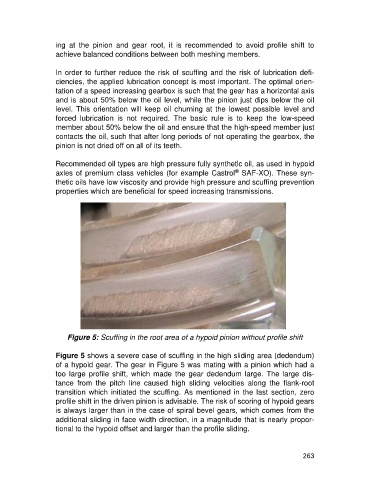
                       Figure 5: Scuffing in the root area of a hypoid pinion without profile shift

                   Figure 5 shows a severe case of scuffing in the high sliding area (dedendum)
                   of a hypoid gear. The gear in Figure 5 was mating with a pinion which had a
                   too  large  profile  shift,  which  made  the  gear  dedendum  large.  The  large  dis-
                   tance  from  the  pitch  line  caused  high  sliding  velocities  along  the  flank-root
                   transition  which  initiated  the  scuffing.  As  mentioned  in  the  last  section,  zero
                   profile shift in the driven pinion is advisable. The risk of scoring of hypoid gears
                   is always larger than in the case of spiral bevel gears, which comes from the
                   additional sliding in face width direction, in a magnitude that is nearly propor-
                   tional to the hypoid offset and larger than the profile sliding.


                                                                                                     263

