


Page 283 - Gear Technology Solutions
P. 283
A lubrication film interruption cannot be compensated in the design calculation
                   of the gearset in the case of a higher output inertia. Because the flank separa-
                   tion is more likely with ratios greater than 2, it is required to design the Ease-
                   Off of a gearset with a ratio larger than 2 nearly conjugate and account for the
                   prevention of edge contact in case of deflections and component tolerances,
                                                  ®
                   by applying blended Toprem  and kinematic heel relief.


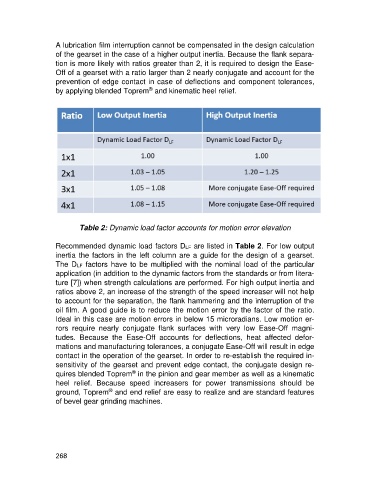
                           Table 2: Dynamic load factor accounts for motion error elevation

                   Recommended dynamic load factors DLF are listed in Table 2. For low output
                   inertia the factors in the left column are a guide for the design of a gearset.
                   The DLF factors  have to be multiplied with the  nominal load  of the  particular
                   application (in addition to the dynamic factors from the standards or from litera-
                   ture [7]) when strength calculations are performed. For high output inertia and
                   ratios above 2, an increase of the strength of the speed increaser will not help
                   to account for the separation, the flank hammering and the interruption of the
                   oil film. A good guide is to reduce the motion error by the factor of the ratio.
                   Ideal in this case are motion errors in below 15 microradians. Low motion er-
                   rors  require  nearly  conjugate  flank  surfaces  with  very  low  Ease-Off  magni-
                   tudes.  Because  the  Ease-Off  accounts  for  deflections,  heat  affected  defor-
                   mations and manufacturing tolerances, a conjugate Ease-Off will result in edge
                   contact in the operation of the gearset. In order to re-establish the required in-
                   sensitivity of the gearset and prevent edge contact, the conjugate design re-
                                             ®
                   quires blended Toprem  in the pinion and gear member as well as a kinematic
                   heel  relief.  Because  speed  increasers  for  power  transmissions  should  be
                                     ®
                   ground, Toprem  and end relief are easy to realize and are standard features
                   of bevel gear grinding machines.


                   268

