


Page 110 - Gear Technology Solutions
P. 110
8.4  Asymmetric Chamfers

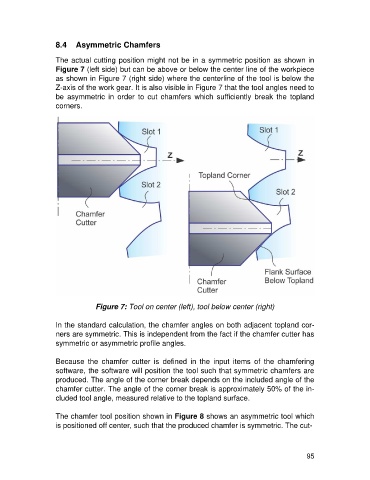
                   The actual cutting position might not be in a symmetric position as shown in
                   Figure 7 (left side) but can be above or below the center line of the workpiece
                   as shown in Figure 7 (right side) where the centerline of the tool is below the
                   Z-axis of the work gear. It is also visible in Figure 7 that the tool angles need to
                   be  asymmetric  in  order  to  cut  chamfers  which  sufficiently  break  the  topland
                   corners.


                                 Figure 7: Tool on center (left), tool below center (right)

                   In the standard calculation, the chamfer angles on both adjacent topland cor-
                   ners are symmetric. This is independent from the fact if the chamfer cutter has
                   symmetric or asymmetric profile angles.

                   Because  the  chamfer  cutter  is  defined  in  the  input  items  of  the  chamfering
                   software, the software will position the tool such that symmetric chamfers are
                   produced. The angle of the corner break depends on the included angle of the
                   chamfer cutter. The angle of the corner break is approximately 50% of the in-
                   cluded tool angle, measured relative to the topland surface.

                   The chamfer tool position shown in Figure 8 shows an asymmetric tool which
                   is positioned off center, such that the produced chamfer is symmetric. The cut-


                                                                                                      95

