


Page 381 - Gear Technology Solutions
P. 381
The outside blade next to it appears balanced; however, there are also unnec-
                   essary amounts of carbide on the shoulders. The lower two graphics in Figure
                   5 present a solution by implementing parallels. Both blade blanks require 20%
                   less  carbide  than  the  blades  in  the  upper  graphic  and  both  blades  are  bal-
                   anced  without  any  cutoffs.  This  solution  had  been  realized  with  rectangular
                                         ®
                   parallels in the RSR  cutter system going back to the 1970’s.


                   27.4  A New Spacer Design

                           ®
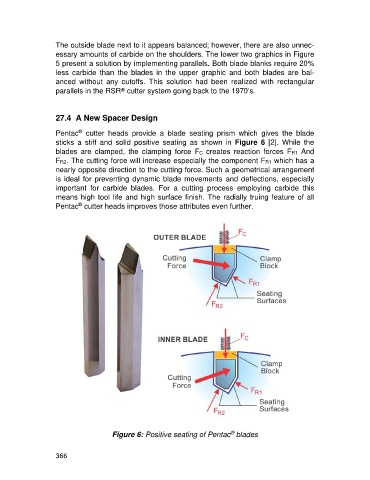
                   Pentac   cutter  heads  provide  a  blade  seating  prism  which  gives  the  blade
                   sticks  a  stiff  and  solid  positive  seating  as  shown  in  Figure  6  [2].  While  the
                   blades  are  clamped,  the  clamping  force  FC  creates  reaction  forces  FR1  And
                   FR2. The cutting force will increase especially the component FR1 which has a
                   nearly opposite direction to the cutting force. Such a geometrical arrangement
                   is ideal  for preventing dynamic blade movements  and deflections,  especially
                   important  for  carbide  blades.  For  a  cutting  process  employing  carbide  this
                   means high tool life and high surface finish. The radially truing feature of all
                           ®
                   Pentac  cutter heads improves those attributes even further.


                                                                             ®
                                      Figure 6: Positive seating of Pentac  blades


                   366

