


Page 382 - Gear Technology Solutions
P. 382
®
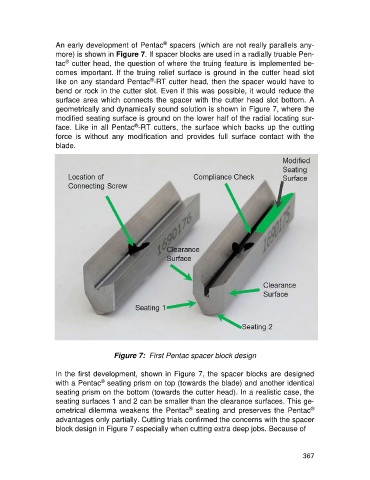
                   An early development of Pentac  spacers (which are not really parallels any-
                   more) is shown in Figure 7. If spacer blocks are used in a radially truable Pen-
                       ®
                   tac  cutter head, the question of where the truing feature is implemented be-
                   comes important. If the truing relief surface is ground in the cutter head slot
                                                   ®
                   like on any standard Pentac -RT cutter head, then the spacer would have to
                   bend or rock in the cutter slot. Even if this was possible, it would reduce the
                   surface  area  which  connects  the  spacer  with  the  cutter  head  slot  bottom.  A
                   geometrically and dynamically sound solution is shown in Figure 7, where the
                   modified seating surface is ground on the lower half of the radial locating sur-
                                              ®
                   face.  Like  in  all  Pentac -RT  cutters,  the  surface  which  backs  up  the  cutting
                   force  is  without  any  modification  and  provides  full  surface  contact  with  the
                   blade.


                                       Figure 7:  First Pentac spacer block design

                   In the first development, shown in Figure 7, the spacer blocks are designed
                                  ®
                   with a Pentac  seating prism on top (towards the blade) and another identical
                   seating prism on the bottom (towards the cutter head). In a realistic case, the
                   seating surfaces 1 and 2 can be smaller than the clearance surfaces. This ge-
                                                                                                        ®
                                                                ®
                   ometrical  dilemma  weakens  the  Pentac   seating  and  preserves  the  Pentac
                   advantages only partially. Cutting trials confirmed the concerns with the spacer
                   block design in Figure 7 especially when cutting extra deep jobs. Because of


                                                                                                     367

