


Page 271 - Gear Technology Solutions
P. 271
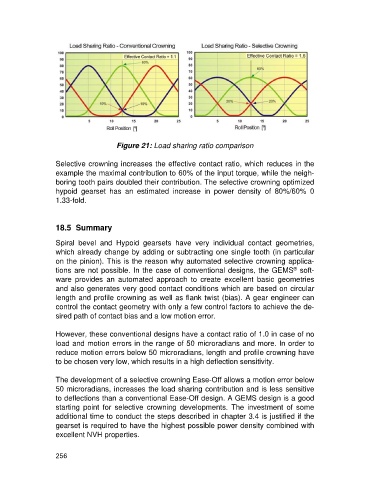
Figure 21: Load sharing ratio comparison

                   Selective crowning increases the effective contact ratio, which reduces in the
                   example the maximal contribution to 60% of the input torque, while the neigh-
                   boring tooth pairs doubled their contribution. The selective crowning optimized
                   hypoid  gearset  has  an  estimated  increase  in  power  density  of  80%/60%  0
                   1.33-fold.


                   18.5  Summary

                   Spiral  bevel  and  Hypoid  gearsets  have  very  individual  contact  geometries,
                   which already change by adding or subtracting one single tooth (in particular
                   on the pinion). This is the reason why automated selective crowning applica-
                   tions are not possible. In the case of conventional designs, the GEMS  soft-
                                                                                                  ®
                   ware  provides  an  automated  approach  to  create  excellent  basic  geometries
                   and also generates very good contact conditions which are based on circular
                   length and profile crowning as well as flank twist (bias). A gear engineer can
                   control the contact geometry with only a few control factors to achieve the de-
                   sired path of contact bias and a low motion error.

                   However, these conventional designs have a contact ratio of 1.0 in case of no
                   load and motion errors in the range of 50 microradians and more. In order to
                   reduce motion errors below 50 microradians, length and profile crowning have
                   to be chosen very low, which results in a high deflection sensitivity.

                   The development of a selective crowning Ease-Off allows a motion error below
                   50 microradians, increases the load sharing contribution and is less sensitive
                   to deflections than a conventional Ease-Off design. A GEMS design is a good
                   starting  point  for  selective  crowning  developments.  The  investment  of  some
                   additional time to conduct the steps described in chapter 3.4 is justified if the
                   gearset is required to have the highest possible power density combined with
                   excellent NVH properties.


                   256

