


Page 231 - Gear Technology Solutions
P. 231
The  modulation  is  applied  in  two  levels.  The  first  and  higher-level  controls  the
                   maximal  flank  form  deviation  amplitude  for  each  individual  tooth.  The  first  level
                   modification control has been defined by a cosine function or by a normal distribu-
                   tion. Also, other mathematical functions or random distributions could be applied
                   to the first level modification.

                   The second and lower level controls the modification on the individual tooth sur-
                   face itself. The second level has been defined as a first order, a third order or a
                   sinusoidal function. The second level modifications on each single tooth are not
                   conducted by common spiral angle and pressure angle corrections, but with roll
                   position dependent functions, which are developed based on the center point of
                   the flanks. Center point developed modifications will not show tooth thickness or
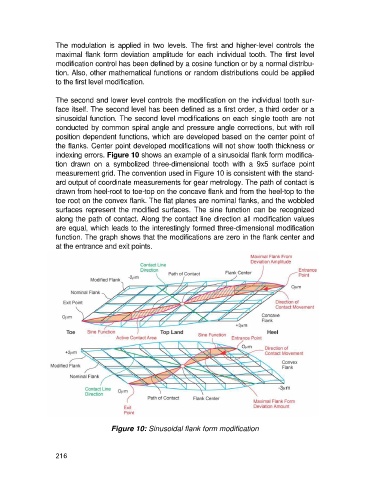
                   indexing errors. Figure 10 shows an example of a sinusoidal flank form modifica-
                   tion  drawn  on  a  symbolized  three-dimensional  tooth  with  a  9x5  surface  point
                   measurement grid. The convention used in Figure 10 is consistent with the stand-
                   ard output of coordinate measurements for gear metrology. The path of contact is
                   drawn from heel-root to toe-top on the concave flank and from the heel-top to the
                   toe root on the convex flank. The flat planes are nominal flanks, and the wobbled
                   surfaces  represent  the  modified  surfaces.  The  sine  function  can  be  recognized
                   along the path of contact. Along the contact line direction all modification values
                   are equal, which leads to the interestingly formed three-dimensional modification
                   function. The graph shows that the modifications are zero in the flank center and
                   at the entrance and exit points.


                                      Figure 10: Sinusoidal flank form modification


                   216

