


Page 226 - Gear Technology Solutions
P. 226
Ground gears show a very high gear quality which is why the amplitude inten-
                   sity of the tooth mesh frequency is particularly high. The attempt to break the
                   high intensity down  by adding spacing errors failed for several reasons. The
                   random tooth spacing errors reduce the gear quality rating which makes it diffi-
                   cult to monitor how sound a grinding production is running. Furthermore, tooth
                   spacing variations reduce the effective contact ratio under load which affects
                   the load carrying capacity of a gearset [8].

                   However,  the  original  goal,  to  reduce  the  vibration  and  noise  emission  of
                   gearsets has failed. In the example in Figure 5 the rack is shifted with a con-
                   stant speed. The gear rotates with a constant RPM while the teeth with a spac-
                   ing of P are in mesh. When the first tooth with a lower spacing P-D 1 contacts
                   the rack, an increased meshing impact and an additional deceleration occur.
                   The following tooth with a larger spacing P+D 2 causes a lower mesh impact
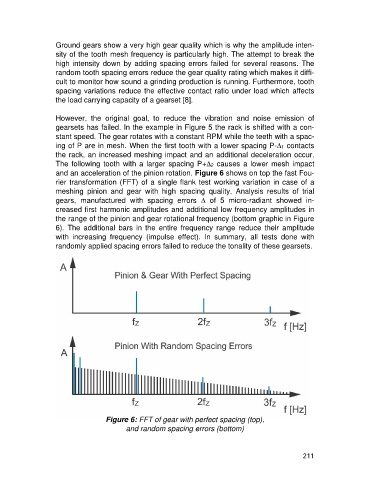
                   and an acceleration of the pinion rotation. Figure 6 shows on top the fast Fou-
                   rier transformation (FFT) of a single flank test working variation in case of a
                   meshing  pinion  and  gear  with  high  spacing  quality.  Analysis  results  of  trial
                   gears,  manufactured  with  spacing  errors  D  of  5  micro-radiant  showed  in-
                   creased first harmonic amplitudes and additional low frequency amplitudes in
                   the range of the pinion and gear rotational frequency (bottom graphic in Figure
                   6).  The  additional  bars  in  the  entire  frequency  range  reduce  their  amplitude
                   with  increasing  frequency  (impulse  effect).  In  summary,  all  tests  done  with
                   randomly applied spacing errors failed to reduce the tonality of these gearsets.


                                    Figure 6: FFT of gear with perfect spacing (top),
                                           and random spacing errors (bottom)


                                                                                                     211

