


Page 236 - Gear Technology Solutions
P. 236
-h
                   Normal Distribution as First Level Function type:   e
                   whereas:
                   -h…  argument of Euler function

                   For the present 13 tooth example, the function should start at tooth number zi = 1
                   with DAmax = 0.01463 as the threshold value. The threshold value is controlled by
                   the chosen 0.1 multiplier in the exponent which delivers in the present example
                   1.463% of the Euler function magnitude. This results in a desirable cutoff before
                   the function travels to an infinitely far away zero value. It should also end at tooth
                   number zi = n+1 with DAmax = 0.01463 as the threshold value.

                                                          =

                   The exponent –h is developed as -h 0.1•(zi-n/2-1)² in order to fulfill the following
                   boundary conditions:

                   With zi = 1 and n = 13 or n/2 = 6.5 it becomes -h= -0.1▪(1-6.5-1)² = -4.225


                   also with zi = n+1 = 14 and n/2 = 6.5 it becomes -h=  0.1▪(14-6.5-1)² = -4.225
                   in case of zi = n/2 = 6.5 it becomes -h=  0


                   With these definitions, the normal distribution becomes:

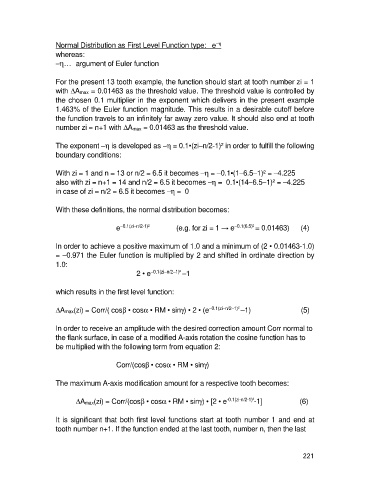
                                       e -0.1(zi-n/2-1)²      (e.g. for zi = 1 → e -0.1(6.5)²  = 0.01463)    (4)

                   In order to achieve a positive maximum of 1.0 and a minimum of (2 • 0.01463-1.0)
                   = -0.971 the Euler function is multiplied by 2 and shifted in ordinate direction by
                   1.0:

                                              2 • e -0.1(zi-n/2-1)²  –1

                   which results in the first level function:

                                                              )
                   DAmax(zi) = Corr/( cosb • cosa • RM • sing • 2 • (e -0.1(zi-n/2-1)²  –1)                       (5)

                   In order to receive an amplitude with the desired correction amount Corr normal to
                   the flank surface, in case of a modified A-axis rotation the cosine function has to
                   be multiplied with the following term from equation 2:


                                       Corr/(cosb cosa • RM • sing
                                                                     )
                                                   •

                   The maximum A-axis modification amount for a respective tooth becomes:

                          DAmax(zi) = Corr/(cosb • cosa • RM • sing) • [2 • e -0.1(zi-n/2-1)² -1]                 (6)

                   It is significant that both first level functions start at tooth number 1 and end at
                   tooth number n+1. If the function ended at the last tooth, number n, then the last


                                                                                                     221

