


Page 225 - Gear Technology Solutions
P. 225
However, the conclusion that unequally spaced gear teeth will accomplish the
                   same mission of reducing noise as discussed with fans and tires is incorrect
                   because the physical principles which are applied in both cases are quite dif-
                   ferent. The wheel in Figure 4 will not change its RPM nor will the vehicle speed
                   change as a result of the random or sinusoidal spaced tire treads. The treads
                   merely have an influence on dynamics and noise generation due to the chang-
                   ing contact frequency between rubber sections and street surface. The analo-
                   gy in gearing is the modulation of the contacting surfaces - not the phase loca-
                   tion of those  surfaces. In other words, this means that  the teeth have  to be
                   equally spaced in order to assure proper function of a gear transmission but
                   the surface texture or the contact characteristic should be shifted within each
                   tooth and from one tooth to the next [8].


                   16.5  Noise Reduction by Scrambling

                   The  expression  “scrambling”  has  been  used  for  the  determined  or  random
                   change of geometrical features from tooth to tooth on gears. One example is
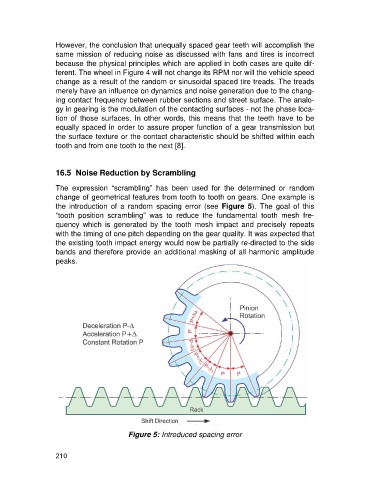
                   the  introduction  of  a  random  spacing  error  (see  Figure  5).  The  goal  of  this
                   “tooth  position  scrambling”  was  to  reduce  the  fundamental  tooth  mesh  fre-
                   quency  which  is  generated  by  the  tooth  mesh  impact  and  precisely  repeats
                   with the timing of one pitch depending on the gear quality. It was expected that
                   the existing tooth impact energy would now be partially re-directed to the side
                   bands and therefore provide an additional masking of all harmonic amplitude
                   peaks.


                                           Figure 5: Introduced spacing error


                   210

