


Page 221 - Gear Technology Solutions
P. 221
matcher such that the processed pressure waves are transferred into the coch-
                   lear fluid. The pressure waves are transmitted by the cochlear fluid to the tec-
                   torial membrane.  The snail  house  shaped cochlear  is lined  with the tectorial
                   membrane which moves hair cells. Along the windings of the cochlear the hair
                   cells  are  sensitive  to  different  frequencies,  performing  a  spectral  analysis  of
                   the sound signal. The hair cell neurons convert the mechanical vibration into
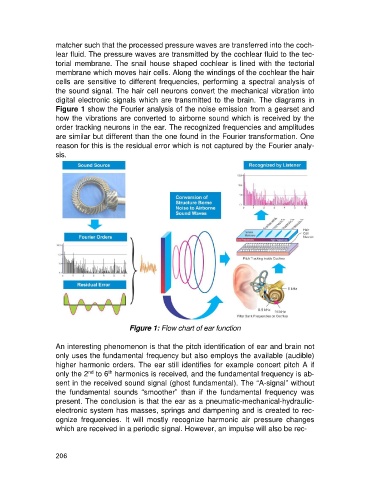
                   digital  electronic signals which  are transmitted to the brain. The diagrams in
                   Figure 1 show the Fourier analysis of the noise emission from a gearset and
                   how the vibrations are converted to airborne sound which is received by the
                   order tracking neurons in the ear. The recognized frequencies and amplitudes
                   are similar but different than the one found in the Fourier transformation. One
                   reason for this is the residual error which is not captured by the Fourier analy-
                   sis.


                                            Figure 1: Flow chart of ear function

                   An interesting phenomenon is that the pitch identification of ear and brain not
                   only uses the fundamental frequency but also employs the available (audible)
                   higher harmonic orders. The ear still identifies for example concert pitch A if
                              nd
                                     th
                   only the 2  to 6  harmonics is received, and the fundamental frequency is ab-
                   sent in the received sound signal (ghost fundamental). The “A-signal” without
                   the  fundamental  sounds  “smoother”  than  if  the  fundamental  frequency  was
                   present. The conclusion is that the ear as a pneumatic-mechanical-hydraulic-
                   electronic system has masses, springs and dampening and is created to rec-
                   ognize  frequencies.  It  will  mostly  recognize  harmonic  air  pressure  changes
                   which are received in a periodic signal. However, an impulse will also be rec-


                   206

