


Page 222 - Gear Technology Solutions
P. 222
ognized, while the ear and brain try to supplement the missing periodicity. The
                   impulse generates bars in the entire frequency range which die down in ampli-
                   tude as the frequency increases. This means that all those frequencies have
                   been found by the Fourier transformation, although the impulse was an isolat-
                   ed occurrence with not really any frequency. The human ear will respond simi-
                   larly because its design will cause an excitation of all hair cells along the wind-
                   ings of the cochlear and send signals of all audible frequencies to the brain.


                   16.3  Typical Gear Noise

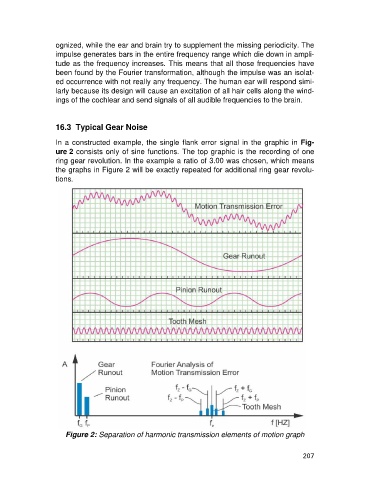
                   In a constructed example, the single  flank error  signal in the graphic in Fig-
                   ure 2 consists only of sine functions. The top graphic is the recording of one
                   ring gear revolution. In the example a ratio of 3.00 was chosen, which means
                   the graphs in Figure 2 will be exactly repeated for additional ring gear revolu-
                   tions.


                       Figure 2: Separation of harmonic transmission elements of motion graph


                                                                                                     207

