


Page 55 - Gear Technology Solutions
P. 55
is directed such that the plane of action appears as a line that is tangential to
                   the two cone enveloping surfaces. The left side graphic in Figure 5 shows the
                   plane  of  action  three-dimensionally  and  how  it  connects  the  two  base  ele-
                   ments.

                   The plane of action cannot be extended beyond its tangential contacting line
                   with the base element as shown in Figure 5. The plane of action only exists
                   where  tooth  engagement  is  possible,  and  it  is  different  than  the  generating
                   gear plane (more specifically explained below).

                   There  is,  however,  one difference  from  the  true involute  of  cylindrical gears.
                   The rotation of pinion and gear does not occur in the normal plane but in the
                   transverse plane. Because of this difference, the flank profile of straight bevel
                   gears (and all other bevel gear types) is called Octoide. The Octoide is the an-
                   alog  function  of  an  involute  and  it  provides  to  bevel  gears  the  same  ad-
                   vantages as an involute provides to cylindrical gears. Those advantages are
                   constant ratio, center distance insensitivity and ease of manufacturing.


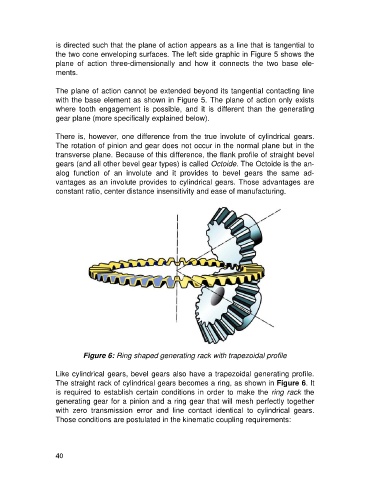
                             Figure 6: Ring shaped generating rack with trapezoidal profile

                   Like cylindrical gears, bevel gears also have a trapezoidal generating profile.
                   The straight rack of cylindrical gears becomes a ring, as shown in Figure 6. It
                   is required  to  establish certain conditions in  order to  make the  ring rack  the
                   generating gear for a pinion and a ring gear that will mesh perfectly together
                   with  zero  transmission  error  and  line  contact  identical  to  cylindrical  gears.
                   Those conditions are postulated in the kinematic coupling requirements:


                   40

