


Page 53 - Gear Technology Solutions
P. 53
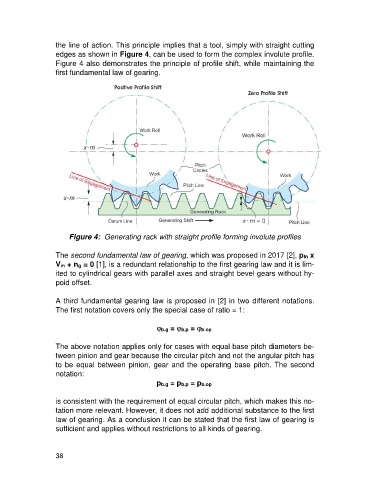
the line of action. This principle implies that a tool, simply with straight cutting
                   edges as shown in Figure 4, can be used to form the complex involute profile.
                   Figure 4 also demonstrates the principle of profile shift, while maintaining the
                   first fundamental law of gearing.


                        Figure 4:  Generating rack with straight profile forming involute profiles

                   The second fundamental law of gearing, which was proposed in 2017 [2], pln x
                   Vm + ng = 0 [1], is a redundant relationship to the first gearing law and it is lim-
                   ited to cylindrical gears with parallel axes and straight bevel gears without hy-
                   poid offset.

                   A third fundamental gearing law is proposed in [2] in two different notations.
                   The first notation covers only the special case of ratio = 1:

                                                     j b.g = j b.p = j b.op

                   The above notation applies only for cases with equal base pitch diameters be-
                   tween pinion and gear because the circular pitch and not the angular pitch has
                   to  be equal between pinion,  gear  and  the operating  base  pitch. The  second
                   notation:
                                                     pb.g = pb.p = pb.op

                   is consistent with the requirement of equal circular pitch, which makes this no-
                   tation more relevant. However, it does not add additional substance to the first
                   law of gearing. As a conclusion it can be stated that the first law of gearing is
                   sufficient and applies without restrictions to all kinds of gearing.


                   38

