


Page 410 - Gear Technology Solutions
P. 410
ter job are changed to the average values of all jobs from the consolidation va-
                   riety (if allowed by input) or adjusted in relation to the maximal value by a cho-
                   sen factor. If, for example, the smallest edge radius is 0.2mm and the largest
                   edge radius is 1.0mm then the average value of 0.6mm is used for the master
                   job in case the edge radius switch is set to “0”. In case the edge radius switch
                   is set to “1”, then the value of the job picked as master is maintained for the
                   master cutter. If the edge radius switch is set to “2”, then an additional factor
                   can be entered (e.g. 0.75) which will be multiplied by the largest edge radius,
                   resulting in edge radii which are 75% of the maximum value of the consolida-
                   tion variety.

                   If for example, the protuberance angles of the consolidation variety is between
                   2° and 4° and the protuberance depth is between 1mm and 3mm then the user
                   can choose the average values of 3° protuberance angle and 2mm protuber-
                   ance depth (switch set to “0”), or set the switch to “1” which maintains the val-
                   ues of the job picked as master. If the switch is set to “2”, then an additional
                   factor can be entered (e.g. 0.6) which will be multiplied by the largest protu-
                   berance angle and depth, resulting in a protuberance angle of 2.4° and a pro-
                   tuberance depth of 1.8mm (60% of the maximum values).

                   One key part of the consolidation is the calculation of the axial cutter position
                   of each individual job “10” in order to accommodate the different blade refer-
                   ence height (blade dedendum) of the master cutter and to assure cutting of the
                   correct  tooth  thickness.  First  in  “10”  the  dedendum  difference  between  the
                   blades of the individual cutter and the blades of the master cutter is calculated
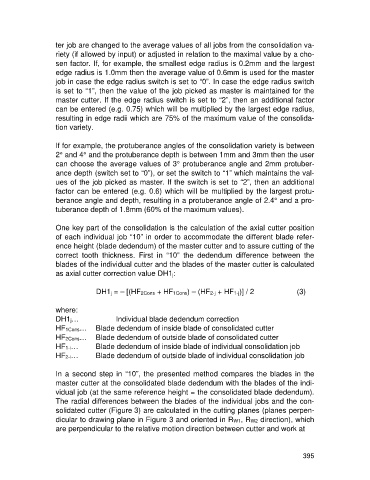
                   as axial cutter correction value DH1j:

                                 DH1j = – [(HF2Cons + HF1Cons) – (HF2-j + HF1-j)] / 2              (3)

                   where:
                   DH1j…               Individual blade dedendum correction
                   HF1Cons…   Blade dedendum of inside blade of consolidated cutter
                   HF2Cons…   Blade dedendum of outside blade of consolidated cutter
                   HF1-i…        Blade dedendum of inside blade of individual consolidation job
                   HF2-i…        Blade dedendum of outside blade of individual consolidation job

                   In  a  second  step in  “10”,  the presented  method compares the  blades in  the
                   master cutter at the consolidated blade dedendum with the blades of the indi-
                   vidual job (at the same reference height = the consolidated blade dedendum).
                   The radial differences between the blades of the individual jobs and the con-
                   solidated cutter (Figure 3) are calculated in the cutting planes (planes perpen-
                   dicular to drawing plane in Figure 3 and oriented in RW1, RW2 direction), which
                   are perpendicular to the relative motion direction between cutter and work at


                                                                                                     395

