


Page 407 - Gear Technology Solutions
P. 407
•  Blade radii of pinion inside and outside blades are calculated from the
                          blade radii of  the  consolidation variety  by  altering them  in  order  to  ar-
                          chive  semi-balanced  amounts  of  deeper  or  shallower  cutting.  Semi-
                          balanced means in this connection that deeper cutting of 80% and shal-
                          lower cutting of 20% of the variation range is optimal for roll conditions
                          and strength:

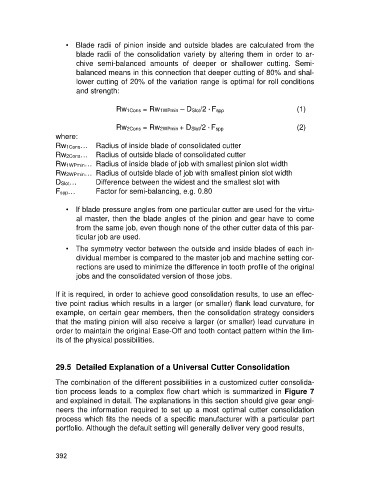
                                       Rw1Cons = Rw1WPmin – DSlot/2 * Fspp                         (1)

                                       Rw2Cons = Rw2WPmin + DSlot/2 * Fspp                         (2)
                   where:
                   Rw1Cons…   Radius of inside blade of consolidated cutter
                   Rw2Cons…   Radius of outside blade of consolidated cutter
                   Rw1WPmin…  Radius of inside blade of job with smallest pinion slot width
                   Rw2WPmin…  Radius of outside blade of job with smallest pinion slot width
                   DSlot…        Difference between the widest and the smallest slot with
                   Fspp…         Factor for semi-balancing, e.g. 0.80

                       •  If blade pressure angles from one particular cutter are used for the virtu-
                          al master, then the blade angles of the pinion and gear have to come
                          from the same job, even though none of the other cutter data of this par-
                          ticular job are used.

                       •  The symmetry vector between the outside and inside blades of each in-
                          dividual member is compared to the master job and machine setting cor-
                          rections are used to minimize the difference in tooth profile of the original
                          jobs and the consolidated version of those jobs.

                   If it is required, in order to achieve good consolidation results, to use an effec-
                   tive point radius which results in a larger (or smaller) flank lead curvature, for
                   example, on certain gear members, then the consolidation strategy considers
                   that the mating pinion will also receive a larger (or smaller) lead curvature in
                   order to maintain the original Ease-Off and tooth contact pattern within the lim-
                   its of the physical possibilities.


                   29.5  Detailed Explanation of a Universal Cutter Consolidation

                   The combination of the different possibilities in a customized cutter consolida-
                   tion process leads to a complex flow chart which is summarized in Figure 7
                   and explained in detail. The explanations in this section should give gear engi-
                   neers  the  information  required  to  set  up  a  most  optimal  cutter  consolidation
                   process which fits the needs of a specific manufacturer with a particular part
                   portfolio. Although the default setting will generally deliver very good results,


                   392

