


Page 405 - Gear Technology Solutions
P. 405
The third  step  of  the inventive  cutter consolidation  applies  the virtual  cutter
                   head to all jobs of the consolidation variety and calculates new machine set-
                   tings for each job which assures the correct tooth thickness, and a minimized
                   pressure angle deviation compared to the original job and considering the in-
                   terplay between pinion and gear.

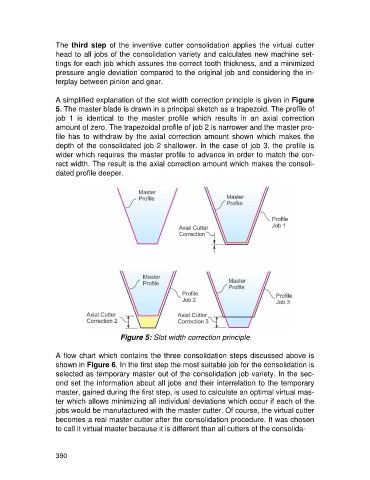
                   A simplified explanation of the slot width correction principle is given in Figure
                   5. The master blade is drawn in a principal sketch as a trapezoid. The profile of
                   job  1  is  identical  to  the  master  profile  which  results  in  an  axial  correction
                   amount of zero. The trapezoidal profile of job 2 is narrower and the master pro-
                   file  has  to  withdraw  by  the  axial  correction  amount  shown  which  makes  the
                   depth of the consolidated job 2 shallower. In the case of job 3, the profile is
                   wider which requires the master profile to advance in order to match the cor-
                   rect width. The result is the axial correction amount which makes the consoli-
                   dated profile deeper.


                                         Figure 5: Slot width correction principle

                   A flow chart which contains the three consolidation steps discussed above is
                   shown in Figure 6. In the first step the most suitable job for the consolidation is
                   selected as temporary master out of the consolidation job variety. In the sec-
                   ond set the information about all jobs and their interrelation to the temporary
                   master, gained during the first step, is used to calculate an optimal virtual mas-
                   ter which allows minimizing all individual deviations which occur if each of the
                   jobs would be manufactured with the master cutter. Of course, the virtual cutter
                   becomes a real master cutter after the consolidation procedure. It was chosen
                   to call it virtual master because it is different than all cutters of the consolida-


                   390

