


Page 411 - Gear Technology Solutions
P. 411
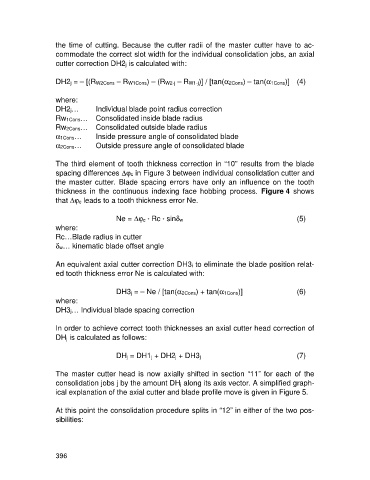
the time of cutting. Because the cutter radii of the master cutter have to ac-
                   commodate the correct slot width for the individual consolidation jobs, an axial
                   cutter correction DH2j is calculated with:

                   DH2j = – [(RW2Cons – RW1Cons) – (RW2-j – RW1-j)] / [tan(a 2Cons) – tan(a 1Cons)]  (4)

                   where:
                   DH2j…         Individual blade point radius correction
                   Rw1Cons…   Consolidated inside blade radius
                   Rw2Cons…   Consolidated outside blade radius
                   a 1Cons…      Inside pressure angle of consolidated blade
                   a 2Cons…      Outside pressure angle of consolidated blade

                   The third element of tooth thickness correction in “10” results from the blade
                   spacing differences Dj c in Figure 3 between individual consolidation cutter and
                   the  master  cutter.  Blade  spacing  errors  have  only  an  influence  on  the  tooth
                   thickness  in  the  continuous  indexing  face  hobbing  process.  Figure 4  shows
                   that Dj c leads to a tooth thickness error Ne.

                                       Ne = Dj c * Rc * sind w                                     (5)
                   where:
                   Rc…Blade radius in cutter
                   d w… kinematic blade offset angle

                   An equivalent axial cutter correction DH3i to eliminate the blade position relat-
                   ed tooth thickness error Ne is calculated with:

                                       DH3j = – Ne / [tan(a 2Cons) + tan(a 1Cons)]                 (6)
                   where:
                   DH3j… Individual blade spacing correction

                   In order to achieve correct tooth thicknesses an axial cutter head correction of
                   DHj is calculated as follows:

                                       DHj = DH1j + DH2j + DH3j                                    (7)

                   The master cutter  head is now axially shifted in section “11” for each of the
                   consolidation jobs j by the amount DHj along its axis vector. A simplified graph-
                   ical explanation of the axial cutter and blade profile move is given in Figure 5.

                   At this point the consolidation procedure splits in “12” in either of the two pos-
                   sibilities:


                   396

