


Page 238 - Gear Technology Solutions
P. 238
with these boundary conditions the second level third order function (Figure 3) be-
                   comes:
                                                                          3
                                                                 3
                                 DA(zi,qj) = DAmax(zi) • [8• (qj-q0) /(qs-qe) ]                          (9)

                   Whereas:
                   qs…  start roll position
                   q0…  center roll position
                   qe…  end roll position


                   16.13   Amplitude and Frequency Change

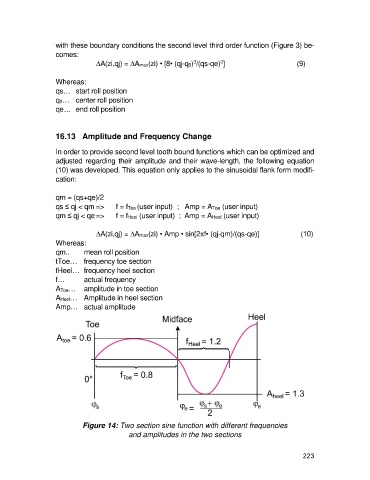
                   In order to provide second level tooth bound functions which can be optimized and
                   adjusted regarding their amplitude and their wave-length, the following equation
                   (10) was developed. This equation only applies to the sinusoidal flank form modifi-
                   cation:

                   qm = (qs+qe)/2
                   qs ≤ qj < qm =>     f = fToe (user input)   ;   Amp = AToe (user input)
                   qm ≤ qj < qe =>     f = fHeel (user input)  ;  Amp = AHeel (user input)

                                 DA(zi,qj) = DAmax(zi) • Amp • sin[2pf• (qj-qm)/(qs-qe)]             (10)
                   Whereas:
                   qm..      mean roll position
                   tToe…  frequency toe section
                   fHeel…  frequency heel section
                   f…        actual frequency
                   AToe…  amplitude in toe section
                   AHeel…  Amplitude in heel section
                   Amp…  actual amplitude


                            Figure 14: Two section sine function with different frequencies
                                            and amplitudes in the two sections


                                                                                                     223

