


Page 195 - Gear Technology Solutions
P. 195
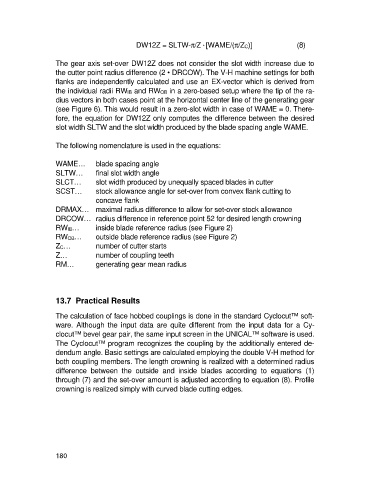
DW12Z = SLTW-p/Z * [WAME/(p/ZC)]                     (8)

                   The gear axis set-over DW12Z does not consider the slot width increase due to
                   the cutter point radius difference (2 • DRCOW). The V-H machine settings for both
                   flanks are independently calculated and use an EX-vector which is derived from
                   the individual radii RWIB and RWOB in a zero-based setup where the tip of the ra-
                   dius vectors in both cases point at the horizontal center line of the generating gear
                   (see Figure 6). This would result in a zero-slot width in case of WAME = 0. There-
                   fore, the equation for DW12Z only computes the difference between the desired
                   slot width SLTW and the slot width produced by the blade spacing angle WAME.

                   The following nomenclature is used in the equations:

                   WAME…         blade spacing angle
                   SLTW…         final slot width angle
                   SLCT…         slot width produced by unequally spaced blades in cutter
                   SCST…         stock allowance angle for set-over from convex flank cutting to
                                 concave flank
                   DRMAX…  maximal radius difference to allow for set-over stock allowance
                   DRCOW…  radius difference in reference point 52 for desired length crowning
                   RWIB…         inside blade reference radius (see Figure 2)
                   RWOB…         outside blade reference radius (see Figure 2)
                   ZC…           number of cutter starts
                   Z…            number of coupling teeth
                   RM…           generating gear mean radius


                   13.7  Practical Results

                   The calculation of face hobbed couplings is done in the standard Cyclocut™ soft-
                   ware.  Although  the  input  data  are  quite  different  from  the  input  data  for  a  Cy-
                   clocut™ bevel gear pair, the same input screen in the UNICAL™ software is used.
                   The Cyclocut™ program recognizes the coupling by the additionally entered de-
                   dendum angle. Basic settings are calculated employing the double V-H method for
                   both coupling members. The length crowning is realized with a determined radius
                   difference  between  the  outside  and  inside  blades  according  to  equations  (1)
                   through (7) and the set-over amount is adjusted according to equation (8). Profile
                   crowning is realized simply with curved blade cutting edges.


                   180

