


Page 192 - Gear Technology Solutions
P. 192
transition includes a generating gear axis set-over rotation. At the end of this set-
                   over, the outside blades form the concave flanks. The cutter withdraws away from
                   the slots and both convex and concave flanks, as well as the slot bottoms, are fin-
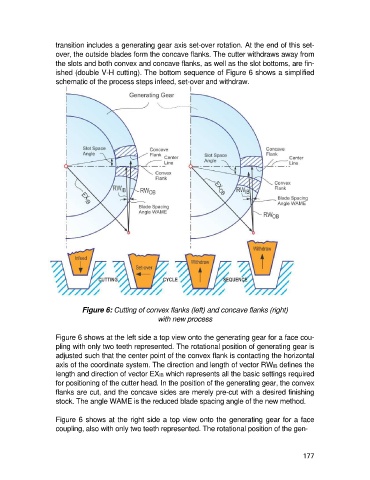
                   ished (double V-H cutting). The bottom sequence of Figure 6 shows a simplified
                   schematic of the process steps infeed, set-over and withdraw.


                            Figure 6: Cutting of convex flanks (left) and concave flanks (right)
                                                     with new process

                   Figure 6 shows at the left side a top view onto the generating gear for a face cou-
                   pling with only two teeth represented. The rotational position of generating gear is
                   adjusted such that the center point of the convex flank is contacting the horizontal
                   axis of the coordinate system. The direction and length of vector RWIB defines the
                   length and direction of vector EXIB which represents all the basic settings required
                   for positioning of the cutter head. In the position of the generating gear, the convex
                   flanks are cut, and the concave sides are merely pre-cut with a desired finishing
                   stock. The angle WAME is the reduced blade spacing angle of the new method.

                   Figure 6 shows at the right side a top view onto the generating gear for a face
                   coupling, also with only two teeth represented. The rotational position of the gen-


                                                                                                     177

