


Page 196 - Gear Technology Solutions
P. 196
13.8  First Example - 24-Tooth Coupling

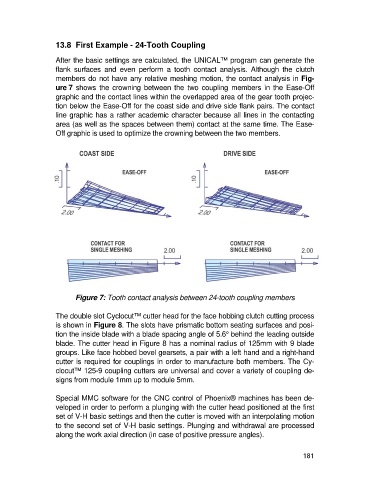
                   After the basic settings are calculated, the UNICAL™ program can generate the
                   flank  surfaces  and  even  perform  a  tooth  contact  analysis.  Although  the  clutch
                   members do not have any relative meshing motion, the contact analysis in Fig-
                   ure 7  shows  the  crowning  between  the  two  coupling  members  in  the  Ease-Off
                   graphic and the contact lines within the overlapped area of the gear tooth projec-
                   tion below the Ease-Off for the coast side and drive side flank pairs. The contact
                   line graphic has a rather academic character because all lines in the contacting
                   area (as well as the spaces between them) contact at the same time. The Ease-
                   Off graphic is used to optimize the crowning between the two members.


                          Figure 7: Tooth contact analysis between 24-tooth coupling members

                   The double slot Cyclocut™ cutter head for the face hobbing clutch cutting process
                   is shown in Figure 8. The slots have prismatic bottom seating surfaces and posi-
                   tion the inside blade with a blade spacing angle of 5.6° behind the leading outside
                   blade. The cutter head in Figure 8 has a nominal radius of 125mm with 9 blade
                   groups. Like face hobbed bevel gearsets, a pair with a left hand and a right-hand
                   cutter is required for couplings in order to manufacture both members. The Cy-
                   clocut™ 125-9 coupling cutters are universal and cover a variety of coupling de-
                   signs from module 1mm up to module 5mm.

                   Special MMC software for the CNC control of Phoenix® machines has been de-
                   veloped in order to perform a plunging with the cutter head positioned at the first
                   set of V-H basic settings and then the cutter is moved with an interpolating motion
                   to the second set of V-H basic settings. Plunging and withdrawal are processed
                   along the work axial direction (in case of positive pressure angles).


                                                                                                     181

