


Page 130 - Gear Technology Solutions
P. 130
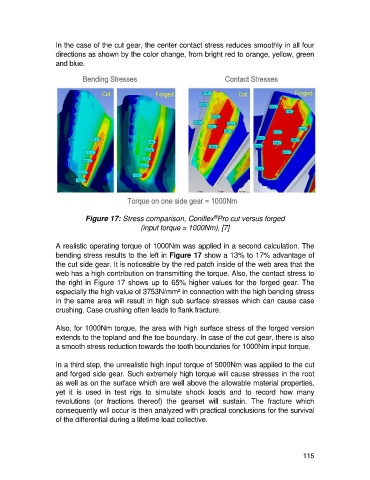
In the case of the cut gear, the center contact stress reduces smoothly in all four
                   directions as shown by the color change, from bright red to orange, yellow, green
                   and blue.


                                                                        ®
                             Figure 17: Stress comparison, Coniflex Pro cut versus forged
                                                (input torque = 1000Nm), [7]

                   A realistic operating torque of 1000Nm was applied in a second calculation. The
                   bending stress results to the left in Figure 17 show a 13% to 17% advantage of
                   the cut side gear. It is noticeable by the red patch inside of the web area that the
                   web has a high contribution on transmitting the torque. Also, the contact stress to
                   the right in Figure 17 shows up to 65% higher values for the forged gear. The
                   especially the high value of 3753N/mm² in connection with the high bending stress
                   in the same area will result in high sub surface stresses which can cause case
                   crushing. Case crushing often leads to flank fracture.

                   Also, for 1000Nm torque, the area with high surface stress of the forged version
                   extends to the topland and the toe boundary. In case of the cut gear, there is also
                   a smooth stress reduction towards the tooth boundaries for 1000Nm input torque.

                   In a third step, the unrealistic high input torque of 5000Nm was applied to the cut
                   and forged side gear. Such extremely high torque will cause stresses in the root
                   as well as on the surface which are well above the allowable material properties,
                   yet  it  is  used  in  test  rigs  to  simulate  shock  loads  and  to  record  how  many
                   revolutions  (or  fractions  thereof)  the  gearset  will  sustain.  The  fracture  which
                   consequently will occur is then analyzed with practical conclusions for the survival
                   of the differential during a lifetime load collective.


                                                                                                     115

