


Page 129 - Gear Technology Solutions
P. 129
9.7  Surface Stress and Root Bending Comparison -
                          Cut versus Forged

                                                                                                ®
                    A root bending stress and surface stress comparison between Coniflex Pro cut
                   and  forged  gears  was  performed  with  the  ANSYS  Finite  Element  Method.  The
                            ®
                   Coniflex Pro  differential  gearset  was  designed  to  replace  the  originally  forged
                   version.  STEP  files  of  the  cut  and  forged  version  had  been  converted  to  the
                   ANSYS native format. Also, a model of the side gear spline was created, and the
                   input torque was transmitted from the splined shaft via the internal spline in the
                   side gear bore to the side gear teeth. A rotational constraint was applied to the
                   planetary pinion in order to create the reaction torque.


                                                                        ®
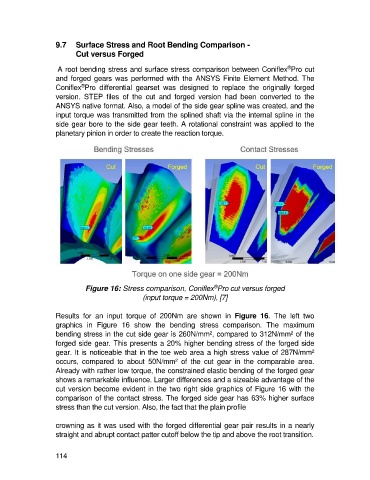
                             Figure 16: Stress comparison, Coniflex Pro cut versus forged
                                                (input torque = 200Nm), [7]

                   Results  for  an  input  torque  of  200Nm  are  shown  in  Figure  16.  The  left  two
                   graphics  in  Figure  16  show  the  bending  stress  comparison.  The  maximum
                   bending stress in the cut side gear is 260N/mm², compared to 312N/mm² of the
                   forged side gear. This presents a 20% higher bending stress of the forged side
                   gear. It is noticeable that in the toe web area a high stress value of 287N/mm²
                   occurs,  compared  to  about  50N/mm²  of  the  cut  gear  in  the  comparable  area.
                   Already with rather low torque, the constrained elastic bending of the forged gear
                   shows a remarkable influence. Larger differences and a sizeable advantage of the
                   cut version become evident in the two right side graphics of Figure 16 with the
                   comparison of the contact stress. The forged side gear has 63% higher surface
                   stress than the cut version. Also, the fact that the plain profile

                   crowning as it was used with the forged differential gear pair results in a nearly
                   straight and abrupt contact patter cutoff below the tip and above the root transition.


                   114

