


Page 124 - Gear Technology Solutions
P. 124
radius.  The  small  amount  of  depth  increase  in  the  center  of  the  face  width
                   increases  the  tooth  thickness  which  dominates  the  effect  from  the  larger  tooth
                   depth at the center. As a result, the curved Coniflex root line reduces the bending
                   stress compared to a straight root line which has been confirmed in practical tests.


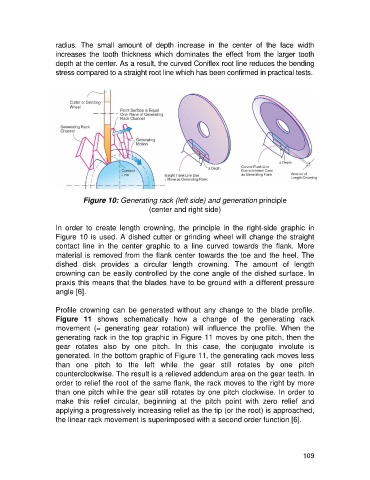
                             Figure 10: Generating rack (left side) and generation principle
                                                  (center and right side)

                   In  order  to  create  length  crowning,  the  principle  in  the  right-side  graphic  in
                   Figure 10 is used. A dished cutter or grinding wheel will change the straight
                   contact  line  in  the  center  graphic  to  a  line  curved  towards  the  flank.  More
                   material is removed from the flank center towards the toe and the heel. The
                   dished  disk  provides  a  circular  length  crowning.  The  amount  of  length
                   crowning can be easily controlled by the cone angle of the dished surface. In
                   praxis this means that the blades have to be ground with a different pressure
                   angle [6].

                   Profile  crowning  can  be  generated  without  any  change  to  the  blade  profile.
                   Figure  11  shows  schematically  how  a  change  of  the  generating  rack
                   movement  (=  generating  gear  rotation)  will  influence  the  profile.  When  the
                   generating rack in the top graphic in Figure 11 moves by one pitch, then the
                   gear  rotates  also  by  one  pitch.  In  this  case,  the  conjugate  involute  is
                   generated. In the bottom graphic of Figure 11, the generating rack moves less
                   than  one  pitch  to  the  left  while  the  gear  still  rotates  by  one  pitch
                   counterclockwise. The result is a relieved addendum area on the gear teeth. In
                   order to relief the root of the same flank, the rack moves to the right by more
                   than one pitch while the gear still rotates by one pitch clockwise. In order to
                   make  this  relief  circular,  beginning  at  the  pitch  point  with  zero  relief  and
                   applying a progressively increasing relief as the tip (or the root) is approached,
                   the linear rack movement is superimposed with a second order function [6].


                                                                                                     109

