


Page 104 - Gear Technology Solutions
P. 104
8        Topland Chamfering


                   8.1  Different Methods for Face Hobbing and Face Milling

                   Bevel and hypoid gears can be cut in a single indexing process (face milling) or in
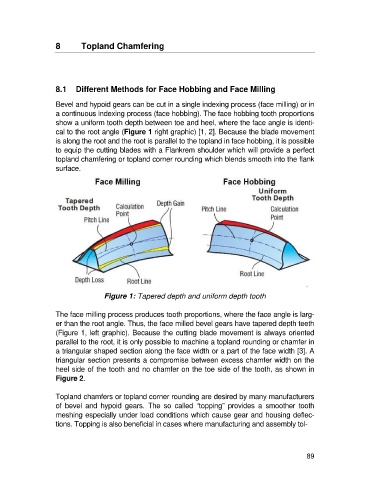
                   a continuous indexing process (face hobbing). The face hobbing tooth proportions
                   show a uniform tooth depth between toe and heel, where the face angle is identi-
                   cal to the root angle (Figure 1 right graphic) [1, 2]. Because the blade movement
                   is along the root and the root is parallel to the topland in face hobbing, it is possible
                   to equip the cutting blades with a Flankrem shoulder which will provide a perfect
                   topland chamfering or topland corner rounding which blends smooth into the flank
                   surface.


                                   Figure 1: Tapered depth and uniform depth tooth

                   The face milling process produces tooth proportions, where the face angle is larg-
                   er than the root angle. Thus, the face milled bevel gears have tapered depth teeth
                   (Figure 1, left graphic). Because the cutting blade movement is always oriented
                   parallel to the root, it is only possible to machine a topland rounding or chamfer in
                   a triangular shaped section along the face width or a part of the face width [3]. A
                   triangular section presents a compromise between excess chamfer width on the
                   heel side of the tooth and no chamfer on the toe side of the tooth, as shown in
                   Figure 2.

                   Topland chamfers or topland corner rounding are desired by many manufacturers
                   of  bevel  and  hypoid  gears.  The  so  called  “topping”  provides  a  smoother  tooth
                   meshing especially under load conditions which cause gear and housing deflec-
                   tions. Topping is also beneficial in cases where manufacturing and assembly tol-


                                                                                                      89

