


Page 101 - Gear Technology Solutions
P. 101
7.6  Surface Optimization during Break-In of a Hunting Tooth Ratio

                   In order to achieve the break-in results described in the last paragraph it is im-
                   perative to design gearsets with hunting tooth ratios. Hunting tooth condition
                   can be established if the number of pinion or gear teeth of an integer ratio or a
                   common  denominator  ratio  is  increased  by  just  one  tooth.  Now,  during  the
                   break-in every pinion tooth will mesh with every gear tooth. The influence of
                   this kinematic difference allows the teeth to become more equal as opposed to
                   developing their individual shapes in groups of 10 (in the above-mentioned ex-
                   ample).


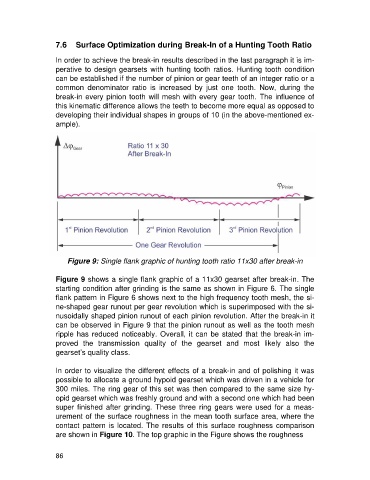
                       Figure 9: Single flank graphic of hunting tooth ratio 11x30 after break-in

                   Figure 9 shows a single flank graphic of a 11x30 gearset after break-in. The
                   starting condition after grinding is the same as shown in Figure 6. The single
                   flank pattern in Figure 6 shows next to the high frequency tooth mesh, the si-
                   ne-shaped gear runout per gear revolution which is superimposed with the si-
                   nusoidally shaped pinion runout of each pinion revolution. After the break-in it
                   can be observed in Figure 9 that the pinion runout as well as the tooth mesh
                   ripple has reduced noticeably. Overall, it can be stated that the break-in im-
                   proved  the  transmission  quality  of  the  gearset  and  most  likely  also  the
                   gearset’s quality class.

                   In order to visualize the different effects of a break-in and of polishing it was
                   possible to allocate a ground hypoid gearset which was driven in a vehicle for
                   300 miles. The ring gear of this set was then compared to the same size hy-
                   opid gearset which was freshly ground and with a second one which had been
                   super finished  after  grinding.  These three ring gears  were used  for  a meas-
                   urement of the surface roughness in the mean tooth surface area, where the
                   contact  pattern is located. The results  of  this surface  roughness  comparison
                   are shown in Figure 10. The top graphic in the Figure shows the roughness


                   86

