


Page 100 - Gear Technology Solutions
P. 100
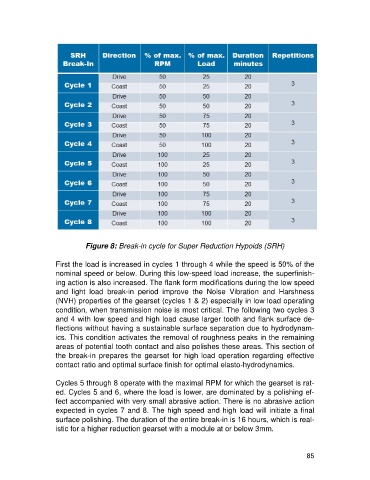
Figure 8: Break-in cycle for Super Reduction Hypoids (SRH)

                   First the load is increased in cycles 1 through 4 while the speed is 50% of the
                   nominal speed or below. During this low-speed load increase, the superfinish-
                   ing action is also increased. The flank form modifications during the low speed
                   and  light  load  break-in  period  improve  the  Noise  Vibration  and  Harshness
                   (NVH) properties of the gearset (cycles 1 & 2) especially in low load operating
                   condition, when transmission noise is most critical. The following two cycles 3
                   and 4 with low speed and high load cause larger tooth and flank surface de-
                   flections without having a sustainable surface separation due to hydrodynam-
                   ics. This condition activates the removal of roughness peaks in the remaining
                   areas of potential tooth contact and also polishes these areas. This section of
                   the break-in prepares the gearset for high load  operation regarding effective
                   contact ratio and optimal surface finish for optimal elasto-hydrodynamics.

                   Cycles 5 through 8 operate with the maximal RPM for which the gearset is rat-
                   ed. Cycles 5 and 6, where the load is lower, are dominated by a polishing ef-
                   fect accompanied with very small abrasive action. There is no abrasive action
                   expected in cycles 7 and 8. The high speed and high load will initiate a final
                   surface polishing. The duration of the entire break-in is 16 hours, which is real-
                   istic for a higher reduction gearset with a module at or below 3mm.


                                                                                                      85

