


Page 403 - Gear Technology Solutions
P. 403
29.4  The Basic Elements of Cutter Consolidation with
                          Virtual Master

                   The new method of job consolidation utilizes a two-step approach which first
                   defines  a  temporary  master  and  in  a  second  step  creates  a  virtual  master
                   which is especially well suited for accommodating the requirements of the jobs
                   in the consolidation variety.

                   In the first step all jobs of the consolidation variety have been analyzed by a
                   computation procedure and the first temporary master is defined as one of the
                   existing jobs of the consolidation variety which cuts the smallest root slot width
                   of  all  jobs  observed.  Then  the  cutters  of  all  other  jobs  are  more  specifically
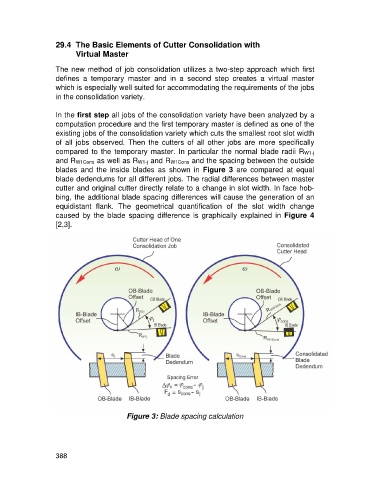
                   compared to the  temporary  master.  In  particular the  normal  blade  radii RW1-j
                   and RW1Cons as well as RW1-j and RW1Cons and the spacing between the outside
                   blades  and  the  inside  blades  as  shown  in  Figure  3  are  compared  at  equal
                   blade dedendums for all different jobs. The radial differences between master
                   cutter and original cutter directly relate to a change in slot width. In face hob-
                   bing, the additional blade spacing differences will cause the generation of an
                   equidistant  flank.  The  geometrical  quantification  of  the  slot  width  change
                   caused  by  the  blade  spacing  difference  is  graphically  explained  in  Figure  4
                   [2,3].


                                           Figure 3: Blade spacing calculation


                   388

