


Page 336 - Gear Technology Solutions
P. 336
angle. The inside blade top and the outside blade top match the average tooth
                   root in Figure 4. The term average tooth root indicates that the real root moves
                   from the outside blade top to the inside blade top location in direction of the
                   gear rotation vector.


                   23.4  Top Slope and Stepping of Cutter Blades for Face Milled
                          Pinions and Gears

                   In generated and Formate face milling processes, stepping of the blades is not
                   used. The major reason is the fact that the tip reference points are significantly
                   closer together as compared to the blade tip reference point distance in a face
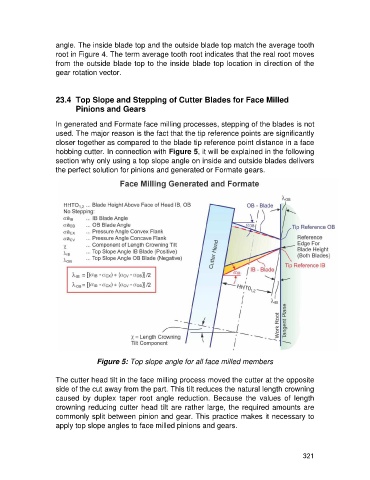
                   hobbing cutter. In connection with Figure 5, it will be explained in the following
                   section why only using a top slope angle on inside and outside blades delivers
                   the perfect solution for pinions and generated or Formate gears.


                                 Figure 5: Top slope angle for all face milled members

                   The cutter head tilt in the face milling process moved the cutter at the opposite
                   side of the cut away from the part. This tilt reduces the natural length crowning
                   caused  by  duplex  taper  root  angle  reduction.  Because  the  values  of  length
                   crowning reducing cutter head tilt are rather large, the required amounts are
                   commonly split between pinion and gear. This practice makes it necessary to
                   apply top slope angles to face milled pinions and gears.


                                                                                                     321

