


Page 333 - Gear Technology Solutions
P. 333
face  cutters  in  order  to  control  the  length  crowning.  Face  milling  completing
                   designs require a tilt angle away from the work piece in order to reduce the
                   length crowning which is introduced by applying a duplex taper. Face milling
                   therefore benefits from a negative top slope angle on the outside cutting blade
                   (as  shown  in  Figure  1)  and  a  positive  top  slope  angle  on  the  inside  cutting
                   blade [1].


                   23.2  Top Slope and Stepping of Cutter Blades for Generated Face
                          Hobbed Members

                   In  face  hobbing,  the  cutting  blade  profiles  do  not  represent  the  generating
                   profile when rotated in one plane like on the face milling blade shown in Figure
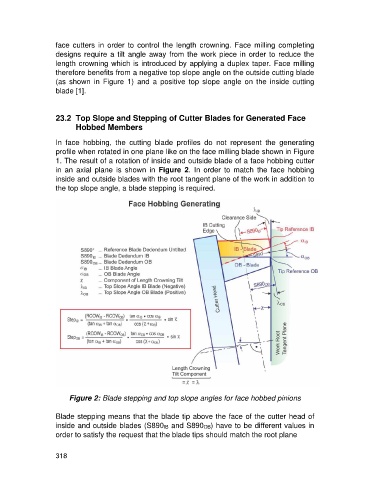
                   1. The result of a rotation of inside and outside blade of a face hobbing cutter
                   in  an  axial  plane  is  shown  in  Figure  2.  In  order  to  match  the  face  hobbing
                   inside and outside blades with the root tangent plane of the work in addition to
                   the top slope angle, a blade stepping is required.


                        Figure 2: Blade stepping and top slope angles for face hobbed pinions

                   Blade stepping means that the blade tip above the face of the cutter head of
                   inside and outside blades (S890IB and S890OB) have to be different values in
                   order to satisfy the request that the blade tips should match the root plane


                   318

