


Page 334 - Gear Technology Solutions
P. 334
without a step. However, in the complex case shown in Figure 2, stepping and
                   top slope are required to ensure root bottoms without fins and steps.

                   Due to the large distance between inside and outside blade tip reference point,
                   the step between S890IB and S890OB is significant. The formal calculation of
                   StepIB and StepOB required the blade point radii, the blade pressure angles and
                   the length crowning  tilt component as documented in Figure 2. Although the
                   combination of top slope angles and stepping in Figure 2 presents the ideal
                   case to achieve a flat and stepless root bottom, there is one inconsequential
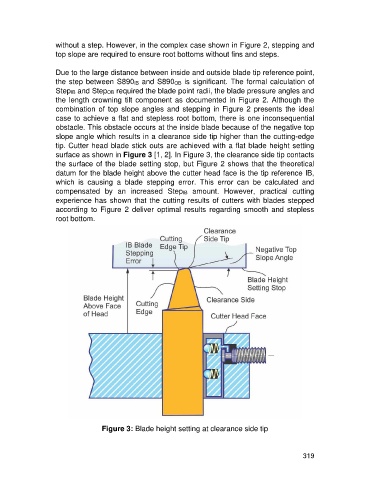
                   obstacle. This obstacle occurs at the inside blade because of the negative top
                   slope angle which results in a clearance side tip higher than the cutting-edge
                   tip. Cutter head blade stick outs are achieved with a flat blade height setting
                   surface as shown in Figure 3 [1, 2]. In Figure 3, the clearance side tip contacts
                   the surface of the blade setting stop, but Figure 2 shows that the theoretical
                   datum for the blade height above the cutter head face is the tip reference IB,
                   which  is  causing  a  blade  stepping  error.  This  error  can  be  calculated  and
                   compensated  by  an  increased  StepIB  amount.  However,  practical  cutting
                   experience has shown that the cutting results of cutters with blades stepped
                   according  to  Figure  2  deliver  optimal  results  regarding  smooth  and  stepless
                   root bottom.


                                   Figure 3: Blade height setting at clearance side tip


                                                                                                     319

