


Page 314 - Gear Technology Solutions
P. 314
The GBX can measure and calculate corrections not only Two-Face Blades
                   like the No. 562, but also Three-Face Blades. Also blades for new methods,
                   such as CONIFLEX®, CONIFACE™ and PowerSkiving blades can be meas-
                   ured and corrected using the Gleason GBX [2].


                   22.4  Technological Blade Angles

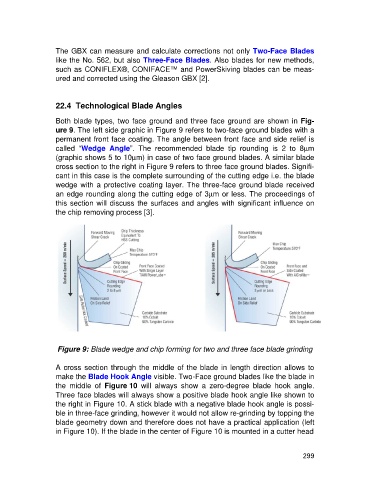
                   Both blade types, two face ground and three face ground are shown in Fig-
                   ure 9. The left side graphic in Figure 9 refers to two-face ground blades with a
                   permanent front face coating. The angle between front face and side relief is
                   called  “Wedge  Angle”.  The  recommended  blade  tip  rounding  is  2  to  8mm
                   (graphic shows 5 to 10mm) in case of two face ground blades. A similar blade
                   cross section to the right in Figure 9 refers to three face ground blades. Signifi-
                   cant in this case is the complete surrounding of the cutting edge i.e. the blade
                   wedge with a protective coating layer. The three-face ground blade received
                   an edge rounding along the cutting edge of 3mm or less. The proceedings of
                   this section will discuss the surfaces and angles with significant influence on
                   the chip removing process [3].


                    Figure 9: Blade wedge and chip forming for two and three face blade grinding

                   A cross section through the middle  of the blade in  length direction allows to
                   make the Blade Hook Angle visible. Two-Face ground blades like the blade in
                   the  middle  of  Figure 10  will  always  show  a  zero-degree  blade  hook  angle.
                   Three face blades will always show a positive blade hook angle like shown to
                   the right in Figure 10. A stick blade with a negative blade hook angle is possi-
                   ble in three-face grinding, however it would not allow re-grinding by topping the
                   blade geometry down and therefore does not have a practical application (left
                   in Figure 10). If the blade in the center of Figure 10 is mounted in a cutter head


                                                                                                     299

