


Page 31 - Gear Technology Solutions
P. 31
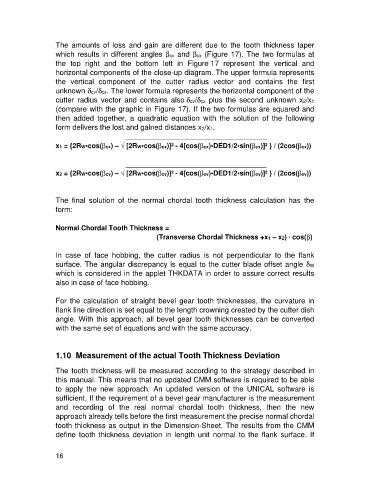
The  amounts  of  loss  and  gain  are  different  due  to  the  tooth  thickness  taper
                   which results in different angles b cv and b cx (Figure 17). The two formulas at
                   the  top  right  and  the  bottom  left  in  Figure 17  represent  the  vertical  and
                   horizontal components of the close-up diagram. The upper formula represents
                   the  vertical  component  of  the  cutter  radius  vector  and  contains  the  first
                   unknown d cv/d cx. The lower formula represents the horizontal component of the
                   cutter  radius  vector  and  contains  also d/d cx  plus  the  second  unknown  x2/x1
                                                                cv
                   (compare with the graphic in Figure 17). If the two formulas are squared and
                   then  added  together,  a  quadratic  equation  with  the  solution  of  the  following
                   form delivers the lost and gained distances x2/x1.
                                                                          ________________________________________________________
                   x1 = {2RW•cos(b cx) – √ [2RW•cos(b cx)]² - 4[cos(b cx)•DED1/2•sin(b cx)]² } / (2cos(b cx))

                                                        _____________________________________
                   x2 = {2RW•cos(b cv) – √ [2RW•cos(b cv)]² - 4[cos(b cv)•DED1/2•sin(b cv)]² } / (2cos(b cv))


                   The  final  solution  of  the  normal  chordal  tooth  thickness  calculation  has  the
                   form:

                   Normal Chordal Tooth Thickness =
                                                     (Transverse Chordal Thickness +x1 – x2) * cos(b )

                   In  case  of  face  hobbing,  the  cutter  radius  is  not  perpendicular  to  the  flank
                   surface. The angular discrepancy is equal to the cutter blade offset angle d W
                   which is considered in the applet THKDATA in order to assure correct results
                   also in case of face hobbing.

                   For  the  calculation  of  straight  bevel  gear  tooth  thicknesses,  the  curvature  in
                   flank line direction is set equal to the length crowning created by the cutter dish
                   angle. With this approach, all bevel gear tooth thicknesses can be converted
                   with the same set of equations and with the same accuracy.


                   1.10  Measurement of the actual Tooth Thickness Deviation

                   The tooth thickness  will be measured  according to the strategy  described  in
                   this manual. This means that no updated CMM software is required to be able
                   to  apply  the  new  approach.  An  updated  version  of  the  UNICAL  software  is
                   sufficient. If the requirement of a bevel gear manufacturer is the measurement
                   and  recording  of  the  real  normal  chordal  tooth  thickness,  then  the  new
                   approach already tells before the first measurement the precise normal chordal
                   tooth thickness as output in the Dimension-Sheet. The results from the CMM
                   define  tooth  thickness  deviation  in  length  unit  normal  to  the  flank  surface.  If


                   16

