


Page 36 - Gear Technology Solutions
P. 36
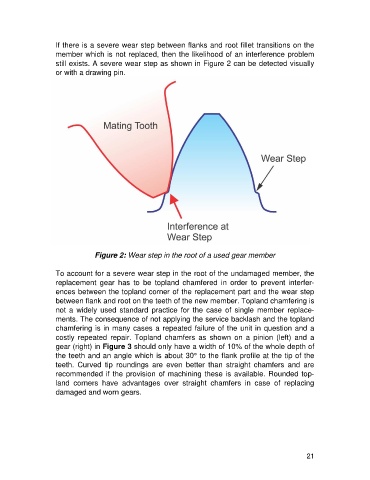
If there is a severe wear step between flanks and root fillet transitions on the
                   member which is not replaced, then the likelihood of an interference problem
                   still exists. A severe wear step as shown in Figure 2 can be detected visually
                   or with a drawing pin.


                                Figure 2: Wear step in the root of a used gear member

                   To account for a severe wear step in the root of the undamaged member, the
                   replacement  gear  has  to  be  topland  chamfered  in  order  to  prevent  interfer-
                   ences between the topland corner of the replacement part and the wear step
                   between flank and root on the teeth of the new member. Topland chamfering is
                   not  a  widely  used  standard  practice  for  the  case  of  single  member  replace-
                   ments. The consequence of not applying the service backlash and the topland
                   chamfering is in many cases a repeated failure of the unit in question and a
                   costly  repeated  repair.  Topland  chamfers  as  shown  on  a  pinion  (left)  and  a
                   gear (right) in Figure 3 should only have a width of 10% of the whole depth of
                   the teeth and an angle which is about 30° to the flank profile at the tip of the
                   teeth.  Curved  tip  roundings  are  even  better  than  straight  chamfers  and  are
                   recommended if the provision of machining these is available. Rounded top-
                   land  corners  have  advantages  over  straight  chamfers  in  case  of  replacing
                   damaged and worn gears.


                                                                                                      21

