


Page 30 - Gear Technology Solutions
P. 30
1.9  Precise Calculation of Normal Chordal Thickness

                   After the software which controls the location of the CMM measurement points
                   was written, it was only possible to obtain the angular tooth thickness based on
                   the  correct  reference  point.  The  steps  to  convert  this  flank  generation  i.e.
                   measurement result into the normal chordal tooth thickness are conducted in
                   the Dimension-Sheet applet THKDATA. The first step is the conversion of the
                   tooth thickness angle DEDI into the transverse chordal tooth thickness DED1,2
                   with the following calculation:

                                    DED1,2 = 2 * (Coordinate Radius) * sin(DEDI/2)

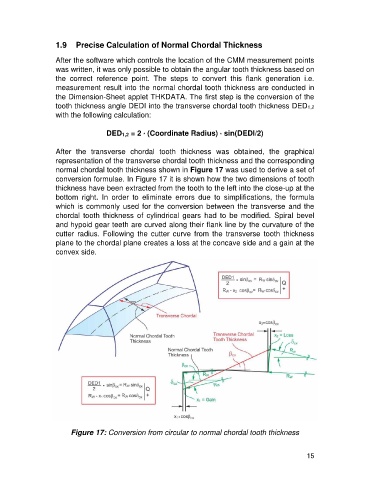
                   After  the  transverse  chordal  tooth  thickness  was  obtained,  the  graphical
                   representation of the transverse chordal tooth thickness and the corresponding
                   normal chordal tooth thickness shown in Figure 17 was used to derive a set of
                   conversion formulae. In Figure 17 it is shown how the two dimensions of tooth
                   thickness have been extracted from the tooth to the left into the close-up at the
                   bottom  right.  In  order  to  eliminate  errors  due  to  simplifications,  the  formula
                   which is  commonly used for the conversion between  the transverse and  the
                   chordal  tooth  thickness  of  cylindrical  gears  had  to  be  modified.  Spiral  bevel
                   and hypoid gear teeth are curved along their flank line by the curvature of the
                   cutter  radius.  Following  the  cutter  curve  from  the  transverse  tooth  thickness
                   plane to the chordal plane creates a loss at the concave side and a gain at the
                   convex side.


                        Figure 17: Conversion from circular to normal chordal tooth thickness


                                                                                                      15

