


Page 147 - Gear Technology Solutions
P. 147
The following sequence of pitch cone representations gives a global explanation of
                   the two-step approach for the proportional (angular) profile shift. In Figure 8, the
                   original pitch cones with the nominal shaft angle are represented as the starting
                   point  of  the  proportional  profile  shift  transformations.  The  pitch  angles  are
                   calculated for cones which roll on an enveloping line without slippage:

                                                     Z1/Z2        = sin g 1I / sin g 2I               (8)
                   with:                             g 2I    = S 2 – g 1I                             (9)
                   (8) plugged in (9) and solved for g 1:


                                                       I
                                                   = arctan(sin(S) / (Z2 / Z1 + cos(S)))    (10)
                                                                  g
                                                      1
                   whereas:
                   g 1 …  pinion pitch angle
                   g 2 …  gear pitch angle
                   Z1…  pinion number of teeth
                   Z2…  gear number of teeth


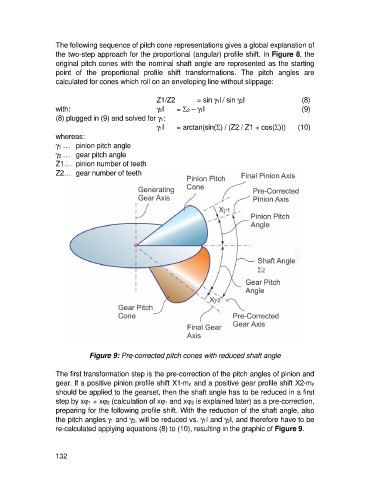
                               Figure 9: Pre-corrected pitch cones with reduced shaft angle

                   The first transformation step is the pre-correction of the pitch angles of pinion and
                   gear. If a positive pinion profile shift X1*mn and a positive gear profile shift X2*mn
                   should be applied to the gearset, then the shaft angle has to be reduced in a first
                   step by xj 1 + xj 2 (calculation of xj 1 and xj 2 is explained later) as a pre-correction,
                   preparing for the following profile shift. With the reduction of the shaft angle, also

                   the pitch angles gand g 2, will be reduced vs. g 1I and g 2I, and therefore have to be
                                      1
                   re-calculated applying equations (8) to (10), resulting in the graphic of Figure 9.


                   132

