


Page 145 - Gear Technology Solutions
P. 145
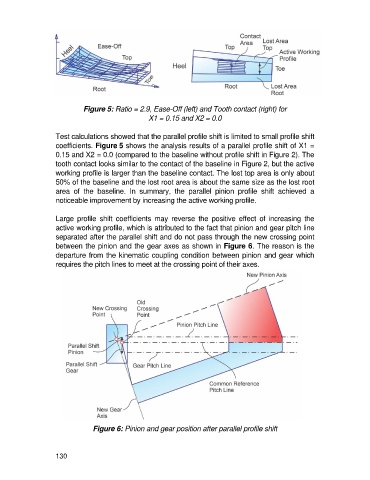
Figure 5: Ratio = 2.9, Ease-Off (left) and Tooth contact (right) for
                                                  X1 = 0.15 and X2 = 0.0

                   Test calculations showed that the parallel profile shift is limited to small profile shift
                   coefficients. Figure 5 shows the analysis results of a parallel profile shift of X1 =
                   0.15 and X2 = 0.0 (compared to the baseline without profile shift in Figure 2). The
                   tooth contact looks similar to the contact of the baseline in Figure 2, but the active
                   working profile is larger than the baseline contact. The lost top area is only about
                   50% of the baseline and the lost root area is about the same size as the lost root
                   area  of  the  baseline.  In  summary,  the  parallel  pinion  profile  shift  achieved  a
                   noticeable improvement by increasing the active working profile.

                   Large  profile  shift  coefficients  may  reverse  the  positive  effect  of  increasing  the
                   active working profile, which is attributed to the fact that pinion and gear pitch line
                   separated after the parallel shift and do not pass through the new crossing point
                   between the pinion and the gear axes as shown in Figure 6. The reason is the
                   departure from the kinematic coupling condition between pinion and gear which
                   requires the pitch lines to meet at the crossing point of their axes.


                                Figure 6: Pinion and gear position after parallel profile shift


                   130

