


Page 142 - Gear Technology Solutions
P. 142
This is especially significant when the number of pinion and gear teeth is equal
                   (miter gears), or if the ratio is near one, like it is in the case of differential gears.
                   Miter gears therefore never receive a profile shift and differential gears only show
                   very small positive pinion profile shift coefficient (for example X1 = +0.15) because
                   the gear profile will develop undercut with the corresponding negative profile shift
                   coefficient (for example X2 = -0.15). Gearsets with larger ratios and a pinion tooth
                   count below 18 also require a profile shift and also in this case, only a limited V0
                   profile  shift is possible.  Figure 2 shows the tooth contact analysis of  a  straight
                   bevel gearset with a ratio of 2.9 without profile shift, which is used as a baseline in
                   the  following  sections.  The  tooth  contact  is  very  small  in  profile  direction.  The
                   number of pinion teeth is 12, which would require a profile shift to increase the
                   active  working  area,  which  is  only  about  50%  of  the  available  profile.  The  lost
                   areas  at  top  and  root  are  large  due  to  physical  pinion  undercut  and  kinematic
                   undercut in the gear.


                   10.2  Independent Parallel Profile Shift

                   Because a change of the shaft angle of a given design is not permissible, at first a
                   profile  shift  was  developed  which  is  parallel  to  the  respective  pitch  line.  The
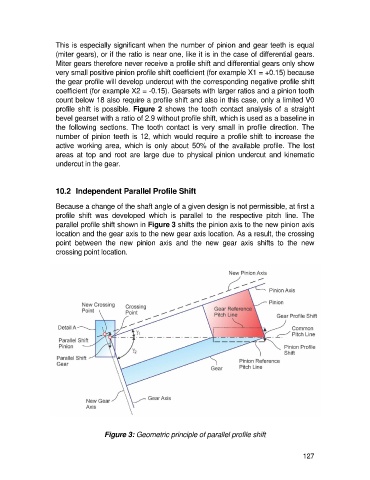
                   parallel profile shift shown in Figure 3 shifts the pinion axis to the new pinion axis
                   location and the gear axis to the new gear axis location. As a result, the crossing
                   point  between  the  new  pinion  axis  and  the  new  gear  axis  shifts  to  the  new
                   crossing point location.


                                    Figure 3: Geometric principle of parallel profile shift


                                                                                                     127

