


Page 140 - Gear Technology Solutions
P. 140
10       Independent Profile Shift for Bevel Gears


                   10.1  The Effect of Profile Shift

                   Bevel  and  hypoid  gears  as  well  as  straight  bevel  gears  require,  similar  to
                   cylindrical  gears, a positive profile shift for  the pinion  in case of low number of
                   teeth.  If  the  number  of  pinion  teeth  is  below  18,  or  even  below  10,  the  pinion
                   develops a severe undercut which eliminates a large portion of the tooth profile in
                   particular at the toe area (small diameter area). This effect leads to a weakening of
                   the tooth root and also a reduction of the flank contact area. As result, the root
                   bending stress and the surface stress are high, and the bevel gear pair has only a
                   fraction  of  the  load  carrying  capacity  compared  to  a  bevel  gearset  without
                   undercut [1].

                   Profile shift has, according to international standards [2], the symbol “X”. In order
                   to determine the amount of profile shift, X is multiplied with the normal module mn
                   of the gear, resulting in the amount of shift.


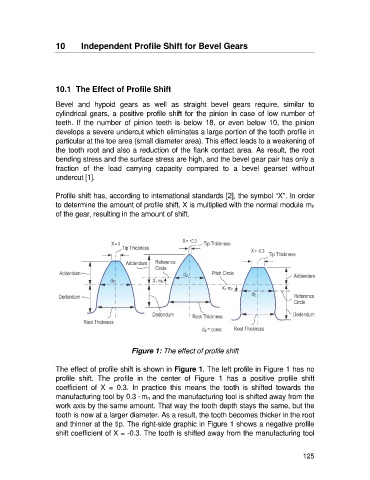
                                             Figure 1: The effect of profile shift

                   The effect of profile shift is shown in Figure 1. The left profile in Figure 1 has no
                   profile  shift.  The  profile  in  the  center  of  Figure  1  has  a  positive  profile  shift
                   coefficient  of  X  =  0.3.  In  practice  this  means  the  tooth  is  shifted  towards  the
                   manufacturing tool by 0.3 * mn and the manufacturing tool is shifted away from the
                   work axis by the same amount. That way the tooth depth stays the same, but the
                   tooth is now at a larger diameter. As a result, the tooth becomes thicker in the root
                   and thinner at the tip. The right-side graphic in Figure 1 shows a negative profile
                   shift coefficient of X = -0.3. The tooth is shifted away from the manufacturing tool


                                                                                                     125

