


Page 96 - Gear Technology Solutions
P. 96
have been rolling with each other, the cycle repeats. The cycle repetition hap-
                   pens after the gear performs a number of revolutions, equal to the number of
                   pinion teeth. This is of course also true if the pinion performs a number of revo-
                   lutions  equal  to  the  number  of  gear  teeth.  The  number  of  revolutions  to
                   achieve “one tooth hunting sequence” is independent from the fact if the num-
                   ber of teeth are prime numbers or if simply both tooth counts have no common
                   denominator, which basically means that none of the two tooth counts has to
                   be a prime number. For example, the ratio 21x22 has no prime number, but by
                   not having a common denominator it will achieve hunting tooth condition.


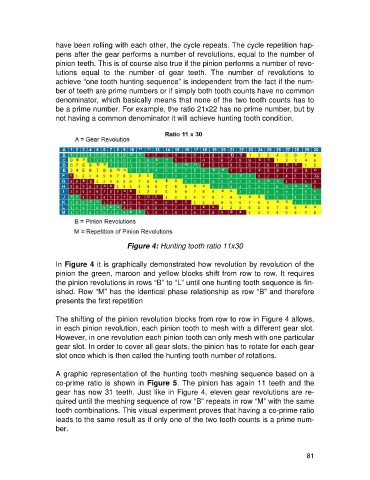
                                           Figure 4: Hunting tooth ratio 11x30

                   In Figure 4 it is graphically demonstrated how revolution by revolution of the
                   pinion the green, maroon and yellow blocks shift from row to row. It requires
                   the pinion revolutions in rows “B” to “L” until one hunting tooth sequence is fin-
                   ished. Row “M” has the identical phase relationship as row “B” and therefore
                   presents the first repetition

                   The shifting of the pinion revolution blocks from row to row in Figure 4 allows,
                   in each pinion revolution, each pinion tooth to mesh with a different gear slot.
                   However, in one revolution each pinion tooth can only mesh with one particular
                   gear slot. In order to cover all gear slots, the pinion has to rotate for each gear
                   slot once which is then called the hunting tooth number of rotations.

                   A graphic representation of the hunting tooth meshing sequence based on a
                   co-prime ratio is  shown in  Figure  5.  The pinion  has  again  11  teeth and  the
                   gear has now 31 teeth. Just like in Figure 4, eleven gear revolutions are re-
                   quired until the meshing sequence of row “B” repeats in row “M” with the same
                   tooth combinations. This visual experiment proves that having a co-prime ratio
                   leads to the same result as if only one of the two tooth counts is a prime num-
                   ber.


                                                                                                      81

