


Page 95 - Gear Technology Solutions
P. 95
7.2  Four Cases of Ratios

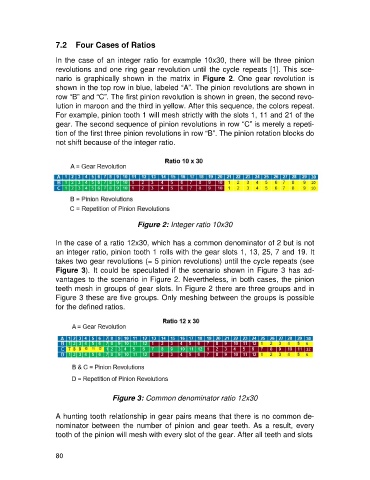
                   In  the case of  an  integer  ratio  for example 10x30, there will  be three  pinion
                   revolutions and one ring gear revolution until the cycle repeats [1]. This sce-
                   nario  is  graphically  shown  in  the  matrix  in  Figure  2.  One  gear  revolution  is
                   shown in the top row in blue, labeled “A”. The pinion revolutions are shown in
                   row “B” and “C”. The first pinion revolution is shown in green, the second revo-
                   lution in maroon and the third in yellow. After this sequence, the colors repeat.
                   For example, pinion tooth 1 will mesh strictly with the slots 1, 11 and 21 of the
                   gear. The second sequence of pinion revolutions in row “C” is merely a repeti-
                   tion of the first three pinion revolutions in row “B”. The pinion rotation blocks do
                   not shift because of the integer ratio.


                                               Figure 2: Integer ratio 10x30

                   In the case of a ratio 12x30, which has a common denominator of 2 but is not
                   an integer ratio, pinion tooth 1 rolls with the gear slots 1, 13, 25, 7 and 19. It
                   takes two gear revolutions (= 5 pinion revolutions) until the cycle repeats (see
                   Figure  3).  It  could  be  speculated  if  the  scenario  shown  in  Figure  3  has  ad-
                   vantages to the scenario in Figure 2. Nevertheless, in both cases, the pinion
                   teeth mesh in groups of gear slots. In Figure 2 there are three groups and in
                   Figure 3 these are five groups. Only meshing between the groups is possible
                   for the defined ratios.


                                      Figure 3: Common denominator ratio 12x30

                   A hunting tooth relationship in gear pairs means that there is no common de-
                   nominator  between  the  number  of  pinion  and  gear  teeth.  As  a  result,  every
                   tooth of the pinion will mesh with every slot of the gear. After all teeth and slots


                   80

