


Page 79 - Gear Technology Solutions
P. 79
ture as shown in Figure 9 is independent from an interference problem. However,
                   because interferences and root transition steps have been observed together on
                   the  same  gears  or  pinions,  it  should  alert  gear  engineers  when  root  transition
                   steps are recognized. Steps and fins at the bottom of the root are rather harmless.
                   They are far enough away from the 30° tangent and are merely an esthetic dis-
                   turbance.


                                                                     ®
                    5.6  Straight Bevel Gears with Coniflex  Plus

                   For common designs with a face width which is equal or smaller than 26% of the
                   cutter radius, the root width is the smallest at the toe and the largest at the heel. In
                   case of larger face widths (smaller cutter radius), the root width between toe and
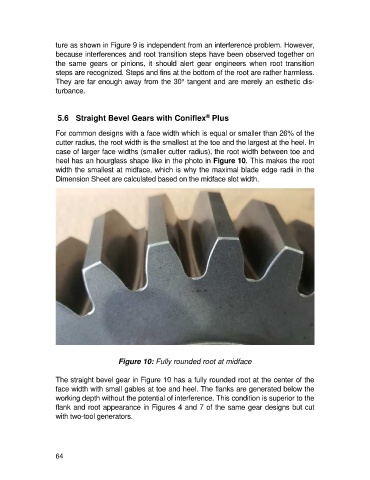
                   heel has an hourglass shape like in the photo in Figure 10. This makes the root
                   width the smallest at midface, which is why the maximal blade edge radii in the
                   Dimension Sheet are calculated based on the midface slot width.


                                        Figure 10: Fully rounded root at midface

                   The straight bevel gear in Figure 10 has a fully rounded root at the center of the
                   face width with small gables at toe and heel. The flanks are generated below the
                   working depth without the potential of interference. This condition is superior to the
                   flank and root appearance in Figures 4 and 7 of the same gear designs but cut
                   with two-tool generators.


                   64

