


Page 82 - Gear Technology Solutions
P. 82
Reducing or eliminating kinematic or physical undercut can be achieved with an
                   increased pressure angle or a larger profile shift. However, restrictions regarding
                   pressure angle or profile shift exist, because both reduce the  topland thickness
                   and the root width.

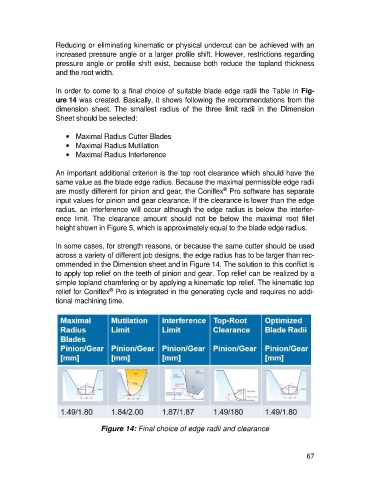
                   In order to come to a final choice of suitable blade edge radii the Table in Fig-
                   ure 14 was created. Basically, it shows following the recommendations from the
                   dimension  sheet.  The  smallest  radius  of  the  three  limit  radii  in  the  Dimension
                   Sheet should be selected:


                       · Maximal Radius Cutter Blades
                       · Maximal Radius Mutilation


                       · Maximal Radius Interference

                   An important additional criterion is the top root clearance which should have the
                   same value as the blade edge radius. Because the maximal permissible edge radii
                                                                           ®
                   are mostly different for pinion and gear, the Coniflex  Pro software has separate
                   input values for pinion and gear clearance. If the clearance is lower than the edge
                   radius, an interference will occur although the edge radius is below the interfer-
                   ence  limit.  The  clearance  amount  should  not  be  below  the  maximal  root  fillet
                   height shown in Figure 5, which is approximately equal to the blade edge radius.

                   In some cases, for strength reasons, or because the same cutter should be used
                   across a variety of different job designs, the edge radius has to be larger than rec-
                   ommended in the Dimension sheet and in Figure 14. The solution to this conflict is
                   to apply top relief on the teeth of pinion and gear. Top relief can be realized by a
                   simple topland chamfering or by applying a kinematic top relief. The kinematic top
                                     ®
                   relief for Coniflex  Pro is integrated in the generating cycle and requires no addi-
                   tional machining time.


                                  Figure 14: Final choice of edge radii and clearance


                                                                                                      67

