


Page 72 - Gear Technology Solutions
P. 72
5        Root Interference


                   5.1  Dimension Sheet Analysis of Root Fillet

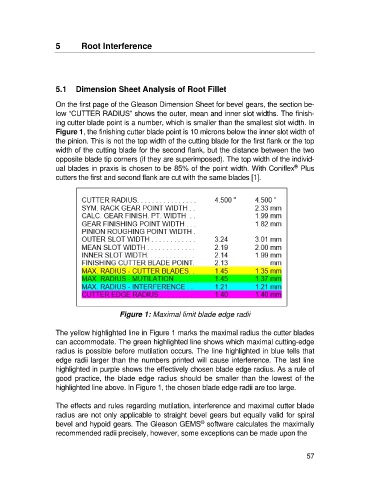
                   On the first page of the Gleason Dimension Sheet for bevel gears, the section be-
                   low “CUTTER RADIUS” shows the outer, mean and inner slot widths. The finish-
                   ing cutter blade point is a number, which is smaller than the smallest slot width. In
                   Figure 1, the finishing cutter blade point is 10 microns below the inner slot width of
                   the pinion. This is not the top width of the cutting blade for the first flank or the top
                   width of the cutting blade for the second flank, but the distance between the two
                   opposite blade tip corners (if they are superimposed). The top width of the individ-
                                                                                                  ®
                   ual blades in praxis is chosen to be 85% of the point width. With Coniflex  Plus
                   cutters the first and second flank are cut with the same blades [1].


                                         Figure 1: Maximal limit blade edge radii

                   The yellow highlighted line in Figure 1 marks the maximal radius the cutter blades
                   can accommodate. The green highlighted line shows which maximal cutting-edge
                   radius is possible before mutilation occurs. The line highlighted in blue tells that
                   edge radii larger than the numbers printed will cause interference. The last line
                   highlighted in purple shows the effectively chosen blade edge radius. As a rule of
                   good  practice,  the  blade  edge  radius  should  be  smaller  than  the  lowest  of  the
                   highlighted line above. In Figure 1, the chosen blade edge radii are too large.

                   The effects and rules regarding mutilation, interference and maximal cutter blade
                   radius are not only applicable to straight bevel gears but equally valid for spiral
                                                                   ®
                   bevel and hypoid gears. The Gleason GEMS  software calculates the maximally
                   recommended radii precisely, however, some exceptions can be made upon the


                                                                                                      57

