


Page 70 - Gear Technology Solutions
P. 70
4.10  Summary

                   Conjugacy  between  the  members  of  straight  bevel,  spiral  bevel  and  hypoid
                   gears was only the first step and goes back more than 100 years. Quickly, the
                   early scientists and engineers found out that conjugacy only gives us an im-
                   portant basis, but not a solution for power transmissions. Angular gearsets un-
                   der load experience deflections that move them away from their theoretical po-
                   sition  by half a  millimeter  and more. Well designed  and manufactured  bevel
                   and hypoid gearsets today can live up to those requirements and still maintain
                   a power density that is four times higher than it was 50 years ago. Transmis-
                   sion errors of 50 to 150 micro-radiant that were normal in the 1970’s are in to-
                   day’s  high-power  density  gearsets  only  between  5  and  15  micro-radiant.  All
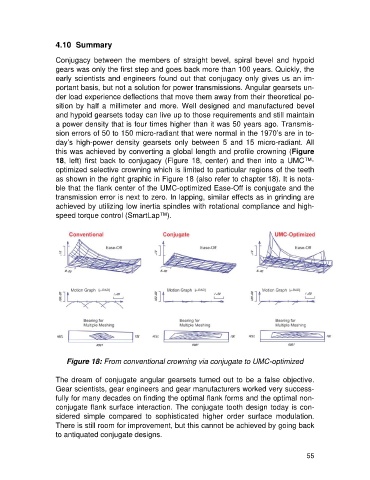
                   this was achieved by converting a global length and profile crowning (Figure
                   18,  left)  first  back  to  conjugacy  (Figure  18,  center)  and  then  into  a  UMC™-
                   optimized selective crowning which is limited to particular regions of the teeth
                   as shown in the right graphic in Figure 18 (also refer to chapter 18). It is nota-
                   ble that the flank center of the UMC-optimized Ease-Off is conjugate and the
                   transmission error is next to zero. In lapping, similar effects as in grinding are
                   achieved by utilizing low inertia spindles with rotational compliance and high-
                   speed torque control (SmartLap™).


                       Figure 18: From conventional crowning via conjugate to UMC-optimized

                   The dream of conjugate angular gearsets turned  out to be  a false objective.
                   Gear scientists, gear engineers and gear manufacturers worked very success-
                   fully for many decades on finding the optimal flank forms and the optimal non-
                   conjugate flank surface interaction. The conjugate tooth design today is con-
                   sidered  simple  compared  to  sophisticated  higher  order  surface  modulation.
                   There is still room for improvement, but this cannot be achieved by going back
                   to antiquated conjugate designs.


                                                                                                      55

