


Page 45 - Gear Technology Solutions
P. 45
The Ease-Offs in Figure 3 have no deviations in vertical direction, which is
                   consequently reflected in zero-motion graphs. This means that the transmis-
                   sion of rotation between pinion and gear follows exactly the ratio given by the
                   tooth count. The contact bearings are full and extend over the entire active
                   working area of the flanks.

                   Such  a  contact  bearing  is  rather  academic  and  cannot  be  used  in  a  power
                   transmission. Tolerances in the gearbox housing, manufacturing deviations of
                   the gears, and load and heat inflicted deformations would quickly cause edge
                   contact and, therefore, a load concentration at the boundaries of the teeth.


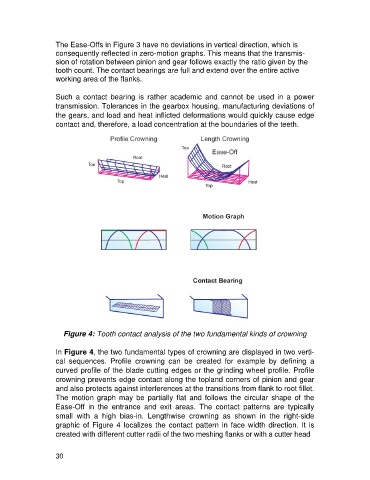
                      Figure 4: Tooth contact analysis of the two fundamental kinds of crowning

                   In Figure 4, the two fundamental types of crowning are displayed in two verti-
                   cal  sequences.  Profile  crowning  can  be  created  for  example  by  defining  a
                   curved profile of the blade cutting edges or the grinding wheel profile. Profile
                   crowning prevents edge contact along the topland corners of pinion and gear
                   and also protects against interferences at the transitions from flank to root fillet.
                   The  motion  graph  may  be  partially  flat  and  follows  the  circular  shape  of  the
                   Ease-Off  in  the  entrance  and  exit  areas.  The  contact  patterns  are  typically
                   small  with  a  high  bias-in.  Lengthwise  crowning  as  shown  in  the  right-side
                   graphic of Figure  4  localizes  the  contact pattern  in face width direction.  It is
                   created with different cutter radii of the two meshing flanks or with a cutter head


                   30

